In today’s digital age, understanding your website’s performance is more critical than ever. Businesses rely on data to make informed decisions, improve user experiences, and boost sales. Google Analytics is one of the most popular tools for tracking and analyzing website data. It’s a powerful tool used by millions around the world.
However, Google Analytics might be a better fit. Some businesses look for alternatives due to privacy concerns, the need for specific features, or just wanting something more straightforward to use. Luckily, many other analytics tools can meet different needs and preferences.
This guide will explore some of the best alternatives to Google Analytics. We’ll examine what makes each tool unique, their pros and cons, and how they compare to Google Analytics. Whether you’re a small business owner or part of a large corporation, this guide will help you find the right analytics tool for your needs.
Criteria for Choosing an Analytics Tool
Choosing the right analytics tool for your business is very important. The right tool helps you understand your customers and make better decisions. Here are some key factors to think about when picking an analytics tool:
Cost
First, consider your budget. Analytics tools come in all price ranges. Some are free, like Google Analytics, while others are expensive. Think about how much you are willing to spend. Ensure you choose a tool that gives you good value for your money.
Features
Look at what each tool offers. Do you need detailed reports, real-time data, or specific integrations? Make a list of the features that are most important for your business. For example, some tools offer heat maps that show where users click the most on your website. Others might provide advanced segmentation to understand different user groups. Choose a tool that has the features you need to meet your goals.
Ease of Use
The tool should be easy to use. You should use it more effectively if it’s too complicated. Look for a tool with a simple interface. It should be easy to navigate and understand. Some tools offer tutorials and guides to help you get started. A user-friendly tool will save you time and make getting the insights you need more accessible.
Integration Capabilities
Check if the tool works well with other software you use. This could include your CRM (Customer Relationship Management), email marketing tools, or e-commerce platform. Good integration means you can easily combine data from different sources. This gives you a complete view of your business and saves you from manually entering data into multiple systems.
Data Privacy and Compliance
Make sure the tool follows data privacy laws like GDPR. This is very important if you handle sensitive customer information. A tool that values privacy will keep your data safe. Look for tools that offer data encryption and secure storage. Also, check if they have certifications or follow industry standards for data protection.
Customer Support
Good customer support is crucial. Look for tools that offer helpful resources, like tutorials and live chat support. This can make a big difference if you run into any issues. Some tools provide 24/7 support, while others might only be available during business hours. Check the level of support offered and make sure it meets your needs.
Consider these factors to find an analytics tool that fits your business needs. Remember, the best tool for one business might not be the best for another. Choose the one that aligns with your goals and requirements.
Top 5 Google Analytics Alternatives
Google Analytics is a popular choice for website analytics. However, some businesses may prefer better alternatives. Here are five great options that offer unique features and benefits.
Matomo
Matomo is an open-source analytics tool that gives you complete control over your data. Here’s why it’s a great alternative to Google Analytics:
Data Ownership: With Matomo, you own your data. You can store it on your servers or choose a cloud option. This is important for businesses concerned about privacy.
Features: Matomo offers many features similar to those of Google Analytics. It includes visitor logs, heat maps, and session recordings. You can see what users do on your site and understand their behavior.
Ease of Use: The interface is user-friendly. Even if you need to be more tech-savvy, you can navigate through and find the necessary information: Matomo integrates well with many platforms. Whether using WordPress, Joomla, or another CMS, Matomo can fit right in.
Cost: Matomo offers a free self-hosted version and a paid cloud version, which start at a reasonable price. This makes it a flexible option for different budgets.
Adobe Analytics
Adobe Analytics is a powerful tool used by many large businesses. It offers advanced features and deep insights.
Advanced Reporting: Adobe Analytics provides detailed reports. You can also create custom dashboards and visualizations to see the metrics that most matter to you.
Real-Time Data: With real-time data, you can see what’s happening on your site as it happens. This is useful for monitoring live events or promotions.
Integration: Adobe Analytics integrates with other Adobe products like Adobe Experience Cloud. This can provide a seamless experience if you’re already using Adobe tools.
Customization: The tool is highly customizable. You can set up specific tracking for unique events or goals on your site.
Cost: Adobe Analytics is a premium product and can be expensive. It’s best suited for larger businesses with bigger budgets.
Piwik PRO
Piwik PRO is similar to Matomo but focuses more on privacy and compliance.
Privacy: Piwik PRO is designed with privacy in mind. It helps businesses comply with GDPR and other privacy laws. Your data is stored securely, and you have complete control over it.
Features: Piwik PRO offers comprehensive features, including user profiles, funnels, and custom reports. You can track user journeys and see how they interact with your site.
Ease of Use: The interface is straightforward to navigate. Even beginners can get valuable insights without much hassle.
Integration: Piwik PRO integrates with many third-party tools. This includes popular CMS platforms and marketing tools.
Cost: Piwik PRO offers a free version with basic features. For more advanced features, there is a paid version. The pricing is flexible and can fit different business sizes.
Mixpanel
Mixpanel is an excellent tool for businesses needing to detail user interactions.
Event Tracking: Unlike traditional page view tracking, Mixpanel focuses on events. You can track user actions on your site or app, such as button clicks or form submissions.
User Segmentation: Mixpanel allows you to segment users based on their behavior. This helps you understand different user groups and tailor your marketing efforts.
Ease of Use: The interface is intuitive. You can set up tracking and create reports without needing technical skills.
Integration: Mixpanel integrates with many other tools, such as CRMs and marketing platforms, making it easy to combine data from different sources.
Cost: Mixpanel offers a free version with basic features. Paid plans are available for more advanced features. The pricing can be higher, but it provides good value for detailed analytics.
Heap
Heap is a user-friendly analytics tool that focuses on automatic data collection.
Automatic Tracking: Heap tracks every user interaction automatically. You don’t need to set up specific events or tags, making it easy to get started and ensuring you get all the data.
User Insights: Heap provides detailed user insights. You can see what users do on your site and how they navigate through it.
Ease of Use: The tool is straightforward to use. You can create reports and analyze data without any technical knowledge.
Integration: Heap integrates with various tools, including CRMs and email marketing platforms. This helps you get a complete view of your user data.
Cost: Heap offers a free version with essential features and paid plans for more advanced features. The pricing is competitive and suitable for different business sizes.
How to Transition to a New Analytics Tool
Switching to a new analytics tool can seem challenging, but you can make the process smooth and thrive with the proper steps. Here’s a simple guide to help you transition to a new analytics tool.
Evaluate Your Needs
Before you switch, understand what you need from your new analytics tool. Ask yourself questions like:
What features are most important for my business?
Do I need real-time data or detailed reports?
How important is data privacy to me?
Make a list of your requirements. This will help you choose a tool that fits your needs.
Choose the Right Tool
Once you know your needs, start researching different analytics tools. Compare their features, costs, and ease of use. Look for reviews and testimonials from other users. Ensure the tool you choose aligns with your business goals and is easy for your team.
Plan the Transition
Planning is critical to a smooth transition. Create a step-by-step plan that includes:
When will you start the transition
Who will be responsible for different tasks
How you will handle data migration
Set clear timelines and assign tasks to team members. Having a plan in place will help you stay organized and avoid disruptions.
Backup Your Data
Before you make any changes, backup your existing data. This ensures you keep essential information during the transition. Export your data from your current analytics tool and save it securely. This way, you have a copy to refer to if anything goes wrong.
Set Up the New Tool
Next, set up your new analytics tool. Follow the installation instructions provided by the tool’s vendor. This usually involves adding tracking codes to your website. Make sure the tool is correctly installed and tracking data is accurate.
Migrate Your Data
Migrate your old data to the new tool. Some analytics tools offer data import features. If this is impossible, keep your old data in a separate file for reference. This helps you maintain historical data and compare past performance with new data.
Train Your Team
Make sure your team knows how to use the new tool. Provide training sessions and resources to help them get familiar with the new interface and features. Many analytics tools offer tutorials and customer support to help you get started.
Monitor the Transition
Keep an eye on the transition process. Check that the new tool is collecting data correctly and that reports are accurate. If you notice any issues, address them quickly. Regular monitoring helps you catch and fix problems early.
Update Your Processes
Update your business processes to include the new analytics tool. This might involve changing how you collect data, analyze reports, or share insights with your team. Make sure everyone understands the latest processes and follows them consistently.
Review and Optimize
After the transition, review how the new tool works for you. Are you getting the insights you need? Is the tool easy to use? Collect feedback from your team and look for ways to optimize your tool use. Regular reviews help you get the most out of your analytics tool.
Transitioning to a new analytics tool doesn’t have to be complicated. By following these steps, you can make the process smooth and ensure you continue to get valuable insights from your data. Remember, planning and communication are critical to a successful transition.
Understanding your website’s performance is crucial for success in the digital world. While Google Analytics is a powerful tool, there are other options. Many businesses seek alternatives for various reasons, such as privacy concerns, the need for specific features, or ease of use.
This guide has explored top alternatives to Google Analytics, including Matomo, Adobe Analytics, Piwik PRO, Mixpanel, and Heap. Each tool offers unique features and benefits that can help you gain deeper insights into your website’s performance and user behavior.
Matomo stands out for its focus on data ownership and privacy. Adobe Analytics offers advanced reporting and integration capabilities, making it ideal for larger businesses. Piwik PRO emphasizes compliance with privacy laws, while Mixpanel and Heap provide detailed user interaction tracking and ease of use.
In today’s digitally-driven world, online reviews have emerged as a driving force behind consumer decisions and brand reputation. Among the plethora of review platforms, Google reviews are a pivotal factor that can make or break a business. However, ethical review generation practices have become paramount in pursuing positive reviews and increased visibility.
Now, we will delve into the significance of ethical review generation and how genuine reviews contribute to long-term business success. Let’s explore how maintaining ethical practices builds customer trust and paves the way for sustained growth and prosperity.
How does Google Review work?
Google reviews function as a user-generated rating and feedback system integrated into Google’s search and business listing platform. They allow customers and clients to share their experiences and opinions about a business, product, service, or location, which can be seen by other potential customers searching for information or considering engaging with that particular business. Here’s how Google reviews work:
Google My Business (GMB) Listing: To enable Google reviews for a business, the business owner or manager needs to create and claim a Google My Business listing. GMB is a free tool that allows businesses to manage their online presence on Google, including their appearance on Google Search and Google Maps.
Customer Reviews: Once a business has a verified GMB listing, customers who interact with the company can leave their reviews on the GMB profile. These reviews include a star rating (1 to 5 stars) and a written examination or comment.
Search and Map Results: When potential customers search for a specific business or related keywords on Google Search or Google Maps, Google displays the business’s GMB listing, including its star rating and the total number of reviews. This information helps users make informed decisions based on the experiences of others.
Sort and Filter Options: Google allows users to sort and filter reviews based on different criteria, such as the most recent reviews, highest-rated reviews, or specific keywords mentioned in reviews. This helps users find the most relevant and helpful information quickly.
Review Responses: Business owners or managers can respond to the reviews they receive. They can thank customers for positive feedback, address concerns raised in negative thoughts, and demonstrate their commitment to customer satisfaction.
Impact on Local Search Ranking: Google reviews and other factors influence a business’s local search ranking. A company with more positive reviews and an overall positive rating may rank higher in local search results, making it more visible to potential customers searching for products or services in their area.
Review Guidelines: Google has specific guidelines businesses and reviewers must follow. These guidelines ensure that reviews are fair, honest, and respectful. Any violation of these guidelines, such as posting fake reviews or using inappropriate language, can result in the removal of the study or even the suspension of the business’s GMB listing.
What is the importance of Google Reviews?
The importance of Google reviews cannot be overstated, as they play a pivotal role in shaping a business’s online reputation and influencing consumer decisions. In today’s digital world, customers heavily rely on online reviews to make informed choices about where to spend their time and money. Positive Google reviews act as beacons of trust and credibility, guiding potential customers toward businesses with proven track records of customer satisfaction.
When customers search for products, services, or local businesses, Google reviews become a source of solace, providing valuable insights into the experiences of others. The positive testimonials resonate with consumers, instilling confidence and validating a business’s reputation. Furthermore, more positive reviews can improve a business’s visibility in local search results, increasing its chances of connecting with potential customers in the local community.
Beyond their role as endorsements, Google reviews offer valuable feedback for businesses. Whether they carry praise or constructive critique, customer feedback becomes a compass for continuous improvement. By listening to their customers, companies can refine their offerings and stay at the forefront of their industry. Here are some key reasons why Google reviews are of great significance:
Building Trust and Credibility: Positive Google reviews act as social proof, instilling trust and credibility in potential customers. When people see that others have had positive experiences with a business, they are more likely to feel confident in choosing that business over competitors.
Influencing Consumer Decisions: Many consumers seek and read online reviews before purchasing or engaging with a business. Google reviews, being easily accessible and prominently displayed in search results and on Google Maps, directly impact consumer decision-making.
Local Search Ranking: Google reviews are critical in determining a business’s local search ranking. A higher quantity of positive thoughts can lead to better visibility in local search results, making it easier for potential customers to find the business online.
Feedback for Improvement: Google reviews provide valuable feedback to businesses. Whether positive or negative, reviews offer insights into what customers appreciate and areas that need improvement. Businesses can use this feedback to enhance their products, services, and overall customer experience.
Customer Engagement and Interaction: Responding to Google reviews allows businesses to engage with their customers directly. By acknowledging positive feedback and addressing negative reviews professionally, businesses demonstrate their commitment to customer satisfaction and build stronger relationships.
Competitive Advantage: Having more positive Google reviews than competitors can give a business a competitive edge. Positive reviews can set a company apart and influence potential customers to choose them over alternatives.
Free Marketing and Word-of-Mouth Advertising: Positive reviews act as testimonials from satisfied customers. When customers share their positive experiences, it serves as free marketing for the business, reaching a broader audience through word-of-mouth.
Open Dialogue with Customers: Google reviews allow customers to share their thoughts and experiences openly. Businesses can listen to their customers’ concerns, respond to feedback, and demonstrate transparency in their operations.
Insights for Business Growth: Businesses can identify their strengths and weaknesses by analyzing review trends and patterns. These insights can inform strategic decisions and contribute to continuous growth.
Brand Reputation Management: Regularly monitoring and responding to Google reviews allows businesses to manage their online reputation effectively. Addressing negative feedback promptly can help mitigate potential damage and showcase a commitment to customer satisfaction.
Different Cases of Google Reviews
Google reviews hold immense importance across various cases, impacting different types of entities, including businesses, e-commerce platforms, and individual products. Let’s explore how Google reviews play a vital role in each of these cases:
Business
Google reviews profoundly impact businesses of all sizes, from local establishments to global enterprises. Positive reviews act as powerful endorsements, attracting customers and boosting the business’s reputation. A higher number of positive reviews can improve the business’s visibility in local search results, helping it stand out in competitive markets. Moreover, customer feedback through reviews provides valuable insights, allowing businesses to continually identify areas for improvement and enhance their products and services.
E-commerce
For e-commerce platforms, Google reviews are crucial to consumer trust and purchase decisions. Potential customers often search for product reviews and seller ratings before making online purchases. Positive reviews build credibility and encourage more shoppers to trust the platform, increasing sales. Additionally, e-commerce businesses can leverage Google reviews to understand customer preferences and identify best-selling products, ultimately optimizing their product offerings.
Product
For individual products, Google reviews directly connect potential buyers and current users. Positive product reviews instill confidence in prospective customers, confirming the product’s quality and suitability for their needs. On the other hand, negative reviews can alert the manufacturer or seller about potential issues and help them address product-related concerns promptly. By responding to product reviews, businesses can demonstrate their commitment to customer satisfaction and build a loyal customer base.
Local Services
Google reviews attract customers for local services such as restaurants, salons, or repair shops. Positive reviews act as virtual recommendations, enticing potential patrons to visit or engage with the service provider. Since customers often search for nearby services, having a solid review profile on Google can significantly impact foot traffic and overall business success.
Hospitality and Tourism
Google reviews are central to decision-making in travel planning and the hospitality and tourism industry. Positive reviews for hotels, resorts, or tourist attractions inspire confidence in travelers, encouraging them to choose specific destinations or accommodations. Negative thoughts also allow businesses to showcase their dedication to customer satisfaction and improvement when addressed professionally.
Health and Professional Services
Google reviews build trust for health and professional services like doctors, dentists, and lawyers. Positive reviews from satisfied patients or clients demonstrate high expertise and care, attracting more people seeking similar services. A robust review profile in these cases can significantly impact a professional’s reputation and clientele.
How To Get Reviews on Google
Obtaining reviews on Google has become critical to establishing a reputable online presence and fostering trust among potential customers. Positive reviews can elevate a brand’s visibility, credibility, and customer loyalty from local establishments to global enterprises. This guide unravels effective strategies to ask for Google reviews, cultivate genuine customer interactions, and ultimately garner more reviews on the world’s most influential search and review platform. Here are the strategies for each category on how to ask for Google reviews and how to get more reviews on Google:
Ask for a Google Review in Person: Train your staff to make a personal connection with customers during their visit. After providing excellent service or completing a transaction, politely ask satisfied customers if they would be willing to share their experience by leaving a Google review. Their feedback is crucial to improving the business and helping others make informed decisions.
Requesting Google Reviews via Email: Send personalized follow-up emails to customers shortly after their interaction with your business. Express gratitude for their support and ask for feedback through a Google review. Include a direct link to your Google review page for their convenience.
Using Social Media for Review Requests: Leverage your social media presence to ask for Google reviews. Share positive customer experiences and testimonials, encouraging followers to share their own experiences by leaving a review on Google. Add a call-to-action to prompt engagement.
Including Review Requests on Invoices or Receipts: Add a review request message or QR code to your invoices or receipts. Politely ask customers to share their experience on Google and consider leaving a review. Make the process simple by providing a direct link.
Creating Review Request Cards: Design review request cards that customers can take after their visit or purchase. These cards can include a QR code or shortened URL leading to your Google review page. Place the cards at your checkout counter or include them in product packaging.
Incorporating Review Requests in Customer Service Emails: Whenever you engage with customers via email for support or follow-ups, include a courteous request for a Google review. Let them know that their feedback matters and will help other customers make informed decisions.
Using Follow-up Surveys to Ask for Reviews: If your business conducts post-interaction surveys, add a section asking if the customer would be willing to leave a Google review. Include a link to your review page for easy access.
Responding to Positive Feedback with a Request: When customers send positive feedback or compliments via email, phone, or in person, take the opportunity to express appreciation and kindly ask if they would consider sharing their thoughts in a Google review.
Including Review Requests in Website Pop-ups: Implement a non-intrusive website pop-up that appears after a customer spends a certain amount of time on your site or completes a specific action. Use this pop-up to request a Google review and link directly to the review page.
Promoting Google Reviews in Newsletters: If your business sends newsletters, add a section inviting subscribers to leave a Google review. Include a brief message expressing gratitude and a link to your review page.
What to expect from people and how to educate them
Understanding what to expect from people when it comes to writing reviews and how to educate them can be a game-changer for businesses seeking to harness the power of customer feedback effectively, whether leaving a review on Google or any other platform, engaging with customers and guiding them to craft thoughtful, constructive, and genuine reviews is essential for building trust, improving products and services, and cultivating lasting customer relationships. Here are some points that you expect from people and educate them:
Highlight the Importance of Feedback: Educating people about the significance of their feedback is essential for encouraging review writing. Emphasize that their reviews can influence future customers’ decisions and help businesses enhance their offerings. Let them know their opinions are valued and crucial to the business’s success.
Encourage Honesty and Authenticity: Stress the importance of honesty in reviews. Educate customers that authentic experiences are more valuable than overly positive or negative feedback. Emphasize that balanced and candid reviews contribute to a trustworthy and transparent review ecosystem.
Provide Clear Guidelines: Many customers may need clarification about what to include in their reviews. Offer clear guidelines on what aspects they can cover, such as product performance, customer service, or delivery speed. Please encourage them to share specific details to provide helpful insights to other potential customers.
Address Common Questions and Concerns: Some customers might hesitate to write reviews due to concerns about the process or potential privacy issues. Address common questions and concerns upfront, reassuring them that the review process is user-friendly and that their personal information will be handled securely.
Offer Incentives Responsibly: While incentives can effectively motivate customers to leave reviews, educate them on the importance of unbiased feedback. Clear that their genuine opinions matter more than any reward and that their honest feedback benefits the business and customers.
Respond to Reviews with Gratitude: Teach businesses the importance of responding to reviews, especially positive ones. When customers see their feedback acknowledged, it encourages further engagement and motivates others to share their experiences. Responding to reviews also showcases the business’s commitment to customer satisfaction.
Address Negative Feedback Professionally: Educate businesses on how to handle negative feedback professionally. Emphasize the importance of viewing negative reviews as opportunities for improvement rather than personal attacks. Encourage enterprises to respond empathetically, address concerns, and offer solutions or resolutions.
Share Examples of Great Reviews: Providing examples of well-written reviews can be inspiring for customers who may need guidance on how to start. Share reviews that effectively highlight positive experiences and constructive feedback. This gives customers a reference point and encourages them to express themselves confidently.
Promote Reviews on Social Media and Websites: Leverage social media and website platforms to showcase customer reviews. Share positive thoughts with the customers’ permission, creating a sense of appreciation and recognition. This public recognition can motivate other customers to share their own experiences.
Celebrate Customer Stories: Sharing success stories from customers who have provided valuable feedback and experienced positive changes can be powerful. Highlight instances where customer feedback led to product improvements or service enhancements. Celebrating customer stories reinforces the impact of their reviews and motivates others to share their experiences.
What to do next after getting a review
After receiving a review, whether it’s a positive or negative one, businesses should take specific actions to maximize the impact of customer feedback and build stronger relationships with their customers. Here’s what to do next after getting a review:
Respond Promptly and Graciously: Acknowledge every review with a timely and sincere response. For positive reviews, express gratitude for the customer’s feedback and their support. For negative reviews, respond professionally, showing empathy and a genuine desire to address their concerns.
Address Concerns and Resolve Issues: For negative reviews, take the conversation offline to resolve the issue privately. Offer solutions or compensation where appropriate, showing the customer that their satisfaction is a top priority.
Share Positive Reviews: Share positive reviews on your website, social media, or promotional materials. Highlighting customer satisfaction reinforces your brand’s credibility and trustworthiness to potential customers.
Learn from Feedback: Analyze customer feedback to identify trends and areas for improvement. Use constructive criticism to enhance products, services, or customer experiences.
Express Appreciation: Consider expressing appreciation to customers who leave reviews by offering a discount on future purchases or a small token of gratitude. This gesture can encourage repeat business and loyalty.
Update FAQs or Knowledge Base: If customers raise recurring questions or concerns in their reviews, update your FAQs or knowledge base to address these topics proactively.
Monitor and Manage Reviews: Continuously monitor your online reviews across platforms. Address any new thoughts promptly, showing you are actively engaged with customer feedback.
Encourage Further Engagement: Use reviews to invite customers to subscribe to newsletters, follow your social media accounts, or join loyalty programs. Engaging with customers beyond the review can lead to long-term relationships.
Use Reviews in Marketing Material: Incorporate snippets of positive reviews in your marketing efforts. Testimonials from satisfied customers can reinforce your brand’s credibility and entice potential customers.
Celebrate Milestones: Celebrate reaching review milestones (e.g., 100 reviews, 5-star rating) by thanking your customers and offering special promotions. Engaging customers in these celebrations fosters a sense of community and loyalty.
Implement Customer Feedback Ideas: If customers suggest improvements or new features in their reviews, consider implementing their ideas and acknowledging their contributions. Involving customers in your business’s evolution strengthens the customer-business relationship.
Learn from Negative Feedback: Negative reviews can be a source of valuable insights. Use them as an opportunity to identify areas for improvement, train your staff, or update policies to prevent similar issues in the future.
How to post a Google review
Leaving a Google review is an impactful way for customers to share their experiences with businesses and help fellow consumers make informed decisions. Whether praising exceptional service or providing valuable feedback for improvement, posting a Google review can significantly influence a business’s reputation and success. In this guide, we’ll walk you through the step-by-step process of how to post a Google review. With just a few clicks and thoughtful words, you can contribute to a thriving review ecosystem, empowering businesses to grow and fostering a community of informed and satisfied customers. Let’s get to know how to do a Google review:
Sign in to Your Google Account: Ensure you are signed in to your Google account. If you don’t have one, create a Google account first.
Search for the Business on Google: Go to Google and search for the business you want to review. To narrow the search results, you can search for the business name followed by the city or location.
Click on the Business Listing: Click on the business listing that matches your search. This will take you to the business’s Google My Business (GMB) page.
Scroll Down to the Review Section: Scroll down the business’s GMB page until you see the review section. You should find a box with stars indicating the business’s overall rating and the number of reviews.
Click on “Write a Review”: Click on the button that says “Write a Review.” This will open a pop-up box where you can compose your review.
Select the Star Rating: Give the business a star rating based on your experience. You can choose from one to five stars, with five being the highest rating.
Write Your Review: Let’s get to know how to write a review on Google. In the text box provided, write your review. Be honest, specific, and provide details about your experience with the business. Mention aspects such as customer service, product quality, or any exceptional experiences you had.
Edit and Preview Your Review (Optional): If you wish to edit your review, you can do so before posting it. Google also provides a preview of how your review will appear to others.
Click “Post”: Once satisfied with your review, click the “Post” button to publish it. Your review will now be visible to others on the business’s Google My Business listing.
Edit or Delete Your Review (Optional): After posting your review, you can edit or delete it. To do this, go back to the business’s GMB page, locate your review, and click on the three dots (ellipsis) next to your review. Select “Edit review” or “Delete review” from the drop-down menu” as desired.
Conclusion
The significance of Google reviews must be considered, as they significantly impact a business’s online reputation and influence consumer decisions. Businesses need to employ various strategies to generate reviews on Google effectively, such as asking for reviews in person, via email, or on social media. Providing clear guidelines and encouraging honesty and authenticity in reviews is crucial.
Businesses should respond graciously to all reviews, promptly addressing concerns and resolving issues. Sharing positive reviews and learning from feedback is essential for continuous improvement. Educating customers on the importance of their reviews and celebrating milestones can further encourage engagement. By embracing the power of customer feedback, businesses can foster trust, build lasting relationships, and thrive in the competitive digital landscape.
Internal linking is a critical component of a comprehensive SEO strategy. Understanding its importance can help you leverage internal links effectively to enhance your website’s visibility and user experience. Here are the key aspects to consider:
How internal linking impacts search engine optimization (SEO): Internal linking plays a significant role in SEO by helping search engines discover, crawl, and index your website’s content. When search engine bots encounter internal links, they follow them to navigate through different pages on your site, effectively exploring and understanding the structure and relationships between your content. This process allows search engines to determine the relevance and value of your pages, contributing to higher rankings in search results.
The role of internal links in distributing link equity and authority: Link equity, also known as link juice, refers to the value or authority passed from one page to another through hyperlinks. Internal links allow you to distribute this link equity across your website, emphasizing the importance of certain pages and helping search engines understand which content is more valuable. By strategically linking to your key pages and cornerstone content, you can boost their visibility and authority, positively influencing their search rankings.
Enhancing user experience and reducing bounce rates through internal links: Internal links can significantly improve user experience by providing logical pathways for visitors to navigate your website. When users encounter relevant internal links within your content, it helps them discover related information, delve deeper into a topic, or explore additional resources. This improves the overall user engagement and encourages them to spend more time on your site, reducing bounce rates. By guiding users to relevant pages, you enhance their satisfaction and increase the likelihood of conversions or further interactions.
By understanding the impact of internal linking on SEO, the distribution of link equity, and the benefits it brings to user experience, you can develop a well-rounded internal linking strategy. Incorporate relevant and contextual internal links throughout your content, prioritize important pages, and ensure a seamless navigation experience for your website visitors.
The Benefits of Internal Linking for Website Visibility
Internal linking offers several benefits that contribute to your website’s visibility in search engine results and overall user engagement. Let’s explore these benefits in detail:
Improving organic search rankings and visibility in SERPs: Internal linking plays a crucial role in improving your website’s organic search rankings. By strategically linking relevant pages and content within your site, you create a network of interconnected information that search engines can easily crawl and understand. This helps search engines recognize the relevance and authority of your pages, potentially leading to higher rankings in search results. When your website ranks higher, it becomes more visible to users searching for related topics, increasing your chances of attracting organic traffic.
Encouraging search engine crawlers to discover and index new content: When search engine crawlers visit your website, they follow internal links to navigate from one page to another. By incorporating internal links throughout your content, you guide these crawlers to discover and index new pages more efficiently. It ensures that your fresh content, such as new blog posts or product pages, is promptly indexed by search engines, making it visible in search results sooner. Regularly adding internal links to your new content helps improve its visibility and accelerates its inclusion in search engine indexes.
Enhancing website navigation and user engagement: Internal links contribute to an improved user experience by providing clear pathways and intuitive navigation on your website. When users encounter relevant internal links within your content, they are more likely to explore additional pages and spend more time on your site. By guiding users to related or complementary content, you enhance their engagement and encourage them to delve deeper into your website. This can lead to increased page views, reduced bounce rates, and higher user satisfaction, all of which contribute to a positive user experience.
By leveraging internal linking to improve search rankings, facilitate the discovery of new content by search engines, and enhance user engagement, you can significantly boost your website’s visibility. Remember to incorporate relevant and contextual internal links, ensure a seamless navigation experience, and regularly evaluate and optimize your internal linking strategy to maximize its benefits.
Best Practices for Effective Internal Linking
To ensure effective internal linking, it’s important to follow best practices that optimize the placement, structure, relevance, anchor text, and maintenance of your internal links. Let’s delve into each of these best practices:
Strategic Link Placement
Identify key pages for internal linking: Determine the most important and authoritative pages on your website that should receive internal link support. These could be cornerstone content, landing pages, or pages with high conversion potential.
Incorporate relevant anchor text for contextual linking: Use descriptive and relevant anchor text that accurately reflects the destination page’s content. This helps both search engines and users understand the context of the link.
Balance the number of internal links per page: While it’s important to provide sufficient internal links, avoid excessive linking that may overwhelm users or dilute the link equity passed to each page. Aim for a balanced and natural link distribution.
Site Structure and Hierarchy
Create a logical website structure for easy navigation: Organize your website into clearly defined categories and subcategories. This logical hierarchy helps users and search engines understand the relationship between different pages and improves overall site usability.
Utilize categories, tags, and related posts for internal linking: Incorporate categories, tags, and related posts sections to enhance internal linking within your website’s content. This allows users to navigate between related topics and helps search engines identify thematic connections.
Implement breadcrumbs for improved user experience: Breadcrumbs provide a visual representation of the user’s location within your website’s hierarchy. They aid in navigation, provide context, and make it easier for users to backtrack or explore related content.
Linking Relevant and Related Content
Link to relevant articles, blog posts, and resources: Integrate internal links within your content to guide users to related and informative pages. This improves the user experience and encourages further engagement.
Utilize “related posts” or “you may also like” sections: Displaying sections that suggest related content can increase user engagement and encourage exploration of additional pages on your website.
Implement internal linking based on topic clusters and content silos: Group related content together under specific topics or themes. Utilize internal links to connect pages within the same topic cluster or content silo, signaling to search engines the depth and breadth of your expertise.
Optimizing Anchor Text
Use descriptive and keyword-rich anchor text: Optimize anchor text to accurately describe the content of the linked page and include relevant keywords when appropriate. This helps search engines understand the topic relevance and enhances the SEO value of the link.
Avoid generic anchor text like “click here” or “read more”: Generic anchor text provides little context for users or search engines. Instead, use descriptive phrases that indicate what users can expect when they click the link.
Keep anchor text natural and user-friendly: Ensure that the anchor text reads naturally within the surrounding content. Avoid keyword stuffing or over-optimization, as this can negatively impact the user experience and SEO.
Monitoring and Updating Internal Links
Regularly audit and update internal links for accuracy: Periodically review your website’s internal links to identify any broken or outdated links. Fix or remove broken links and update them with the correct URLs to maintain a seamless user experience.
Implement redirects for broken or outdated internal links: If you change the URL structure or remove a page, set up appropriate redirects to ensure that internal links pointing to those pages still lead users to relevant content.
Utilize tools and plugins to automate link management: Use tools and plugins that can assist in managing internal links, such as automatically updating links when URLs change or generating related post sections.
By implementing these best practices, you can create a robust internal linking strategy that improves SEO, enhances user experience, and ensures the accuracy and relevance of your internal links over time.
Bonus Content – Internal Linking Method you can apply
Identify target pages for internal linking
To identify target pages for internal linking, you can utilize a combination of tools like Screaming Frog, Google Analytics 4 (GA4) API, and Ahrefs API. Here’s a step-by-step process:
Crawl the site using Screaming Frog:
Use the Screaming Frog SEO Spider tool to crawl your website and gather data about your pages.
Set up the spider to crawl the entire website or specific sections based on your requirements.
Extract data from Google Analytics 4 (GA4) API:
Utilize the GA4 API to extract data related to pageviews, engagement metrics, and conversion rates.
Retrieve information about the popularity and performance of your website’s pages.
Gather data from Ahrefs API:
Utilize the Ahrefs API to gather data on backlinks, organic traffic, and keyword rankings for your website’s pages.
This data helps identify pages with higher authority or visibility.
Combine the data and analyze:
Merge the data obtained from Screaming Frog, GA4 API, and Ahrefs API into a single dataset for analysis.
Analyze the metrics to identify pages that meet specific criteria, such as high traffic, engagement, conversion rates, backlinks, or keyword rankings.
Prioritize target pages for internal linking:
Based on the analysis, identify the pages that align with your internal linking objectives and have the potential to benefit from increased visibility or authority.
Consider pages that already perform well and pages that could benefit from additional internal link support.
Plan your internal linking strategy:
Once you have identified target pages, determine the relevant anchor text and the context in which the internal links will be placed.
Consider the user journey, logical content connections, and the relevance of the target pages to the linking pages.
By utilizing a combination of tools like Screaming Frog, GA4 API, and Ahrefs API, you can gather data-driven insights to identify target pages for internal linking. This approach helps ensure that your internal linking efforts are focused on pages that have the potential to benefit the most from increased visibility, authority, and user engagement.
Using Ahrefs Audit Report and Internal linking
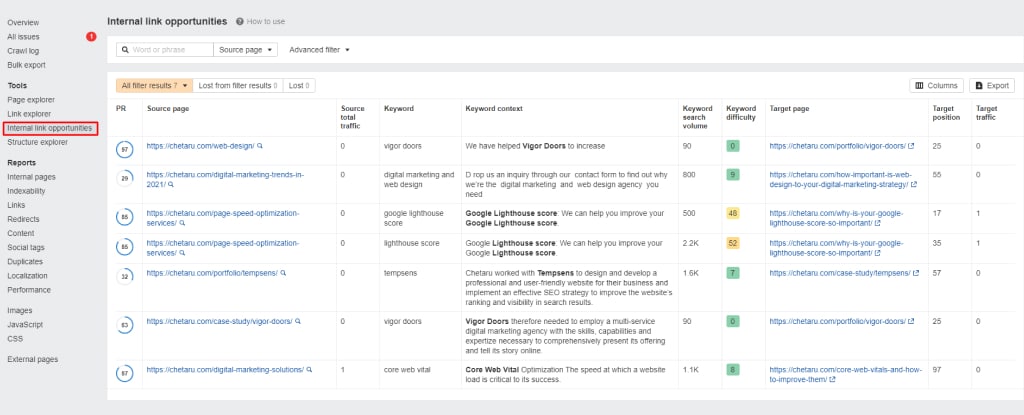
To leverage Ahrefs for internal linking opportunities and add the “Keyword Context” to your analysis, follow these steps:
Set up an audit project in Ahrefs and let it crawl:
Log in to your Ahrefs account and create an audit project for the website you want to analyze.
Configure the project settings, including the website’s crawl depth and any specific areas you want to focus on.
Access the “Internal Linking Opportunities” report:
Once the project has completed crawling, navigate to the “Site Audit” section in Ahrefs.
Select your project and click on the “Internal Linking Opportunities” report.
Add “Keyword Context” to the report:
In the “Internal Linking Opportunities” report, you will see a list of pages on your website.
Look for the option to add columns or customize the view of the report. Click on it to access the customization options.
Search for the “Keyword Context” or similar column and add it to the report view.
Analyze the “Keyword Context” column:
The “Keyword Context” column provides insights into the keywords and topics associated with each page.
Review the keywords listed to understand the content and context of each page.
Identify relevant keywords that can be used as anchor text when linking internally from other pages.
By adding the “Keyword Context” column to the “Internal Linking Opportunities” report in Ahrefs, you gain a deeper understanding of the keywords and topics associated with each page. This information allows you to make informed decisions when selecting anchor text for internal links. You can prioritize linking from pages with relevant keyword context to maximize the SEO value and improve the user experience of your internal linking strategy.
To search for specific target keywords on a particular website using the “site:” operator on Google, follow these steps:
Open your web browser and go to google.com.
In the search bar, enter the following search query, replacing “{domainname}” with the actual domain name of the website you want to search within: site:https://{domainname} “target keyword” For example: site:https://example.com “internal linking”
Press Enter or click on the search button to perform the search.
Google will display the search results, showing all pages from the specified website that include the target keyword you specified. Note: Keep in mind that Google’s search results may vary based on your location, personalization settings, and other factors.
By using the “site:” operator in combination with the target keyword, you can effectively narrow down the search results to only show pages within the specified website that contain the desired keyword. This approach allows you to quickly identify relevant pages on the website that are associated with the target keyword, which can be helpful when analyzing internal linking opportunities or conducting keyword research.
Search Console Approach
To leverage Google Search Console for identifying relevant pages and adding internal links, follow these steps:
Go to your Google Search Console account.
Select the desired property (website) you want to work with.
Navigate to the “Performance” report or “Search Results” section.
Apply a page filter to narrow down the data to a specific section of your website, such as a blog or a specific category.
In the search or query filter, enter the “Target keyword” that you want to focus on.
You can use variations of the keyword or specific phrases to refine the search.
This filter will show data related to queries containing the target keyword.
Analyze the search performance data and identify pages that are already ranking or receiving impressions for the target keyword.
Look for pages with high impressions or click-through rates that indicate their visibility and relevance.
Add internal links from these relevant pages to your target pages.
Identify opportunities where you can naturally incorporate internal links within the content of these pages.
Link from the relevant pages to your target pages using descriptive anchor text that includes the target keyword or related keywords.
Ensure that the internal links are contextually relevant and provide value to users.
Monitor the performance of the target pages in Google Search Console over time to gauge the impact of the internal links and track any improvements in rankings or visibility.
By utilizing Google Search Console’s page and query filters, you can identify relevant pages and queries associated with your target keyword. This data provides valuable insights for adding internal links from high-performing pages to your target pages, helping to improve their visibility and authority within search results. Monitoring the performance of the target pages allows you to assess the effectiveness of the internal linking strategy and make adjustments as needed.
Incorporating an effective internal linking strategy is essential for improving your website’s visibility, SEO performance, and user experience. If you’re looking to optimize your internal linking or need assistance with other aspects of website development and digital marketing, consider leveraging the professional services offered by Chetaru. Our experienced team can help you create a tailored internal linking strategy that aligns with your business goals and maximizes your website’s potential. Get in touch with us today to explore how Chetaru can elevate your website’s performance through strategic internal linking and comprehensive digital solutions.
As an SEO expert, it’s natural to have high expectations for the results of your efforts. However, SEO is a long-term process that requires ongoing monitoring, analysis, and adjustments. It’s not uncommon for a website’s performance to fluctuate despite implementing a well-thought-out SEO plan.
If you’ve been working on your SEO strategy for a considerable period and haven’t seen the expected results, it may indicate the need for an update. Here are a few reasons why updating your strategy might be necessary:
Changing Search Engine Algorithms: Search engines continuously refine their algorithms to provide users with the best possible search experience. These algorithm updates can impact how websites are ranked. If you haven’t adjusted your strategy to align with the latest algorithm changes, it could hinder your website’s performance. Updating your SEO plan will help you adapt to these algorithm updates and improve your chances of ranking well.
Evolving Competition: The online landscape is dynamic, and your competitors are likely making changes to their SEO strategies as well. If you notice that your competitors are outranking you or implementing new tactics, it’s a sign that you need to update your SEO plan. Analyzing their strategies can provide valuable insights and help you identify areas for improvement.
Shifting User Behavior: User behavior and search trends can change over time. If your target audience’s search habits have evolved, it’s important to update your SEO plan accordingly. Conducting fresh keyword research and optimizing your content to match current user intent can help you stay relevant and attract the right audience.
Technical Issues: Technical SEO plays a crucial role in website performance. If your site has technical issues, such as slow page speed, broken links, or poor mobile optimization, it can negatively impact your rankings. Updating your SEO plan to address these technical issues will help improve your website’s overall performance and search visibility.
Content Relevance: The quality and relevance of your content are paramount for SEO success. If you find that your existing content is outdated, lacks depth, or doesn’t align with user intent, it’s time to update your content strategy. Creating fresh, high-quality, and relevant content can help boost your rankings and attract more organic traffic.
Keep in mind that the SEO landscape is constantly evolving, and what worked for your website last year may not be as effective this year. So, stay up-to-date with the latest SEO trends, techniques, and best practices to optimize your website’s performance and stay ahead of the competition. SEO is a dynamic field, and regular updates to your strategy are essential. By staying informed about industry trends, monitoring your website’s performance, and being adaptable, you can make informed decisions to optimize your SEO efforts and achieve the desired results.
When Should You consider Updating Your SEO Plan: Some Signs
Here are some signs that indicate it’s time to consider updating your SEO plan:
Declining Organic Traffic: If you notice a significant drop in organic traffic to your website, it’s a clear sign that something might be wrong with your SEO strategy. Updating your plan can help identify and address the factors contributing to the decline, such as changes in search engine algorithms, competitor strategies, or technical issues.
Poor Keyword Rankings: If your target keywords consistently rank poorly or have dropped in rankings over time, it’s a signal that your SEO plan needs adjustment. Revisit your keyword research and ensure that your content is optimized effectively to improve your rankings and increase organic visibility.
Lack of Conversions or Low Engagement: Even if your website is receiving decent traffic, if it’s not converting visitors into customers or achieving the desired engagement metrics, it’s time to reevaluate your SEO plan. Updating your strategy to focus on improving user experience, optimizing conversion elements, and aligning content with user intent can help improve conversions and engagement metrics.
Outdated or Ineffective Content: If your content hasn’t been performing well or is outdated, it’s a sign to update your content strategy. Conduct a content audit to identify underperforming pieces and gaps in your content. Revise, update, or create new content to meet user needs, align with current search trends, and provide value to your target audience.
Changes in Business Goals or Target Audience: If your business goals or target audience have evolved, your SEO plan should reflect these changes. Consider updating your strategy to align with new objectives, target different keywords, and create content that appeals to the updated target audience.
Competitors Outranking You: If your competitors consistently outrank you in search results, it’s an indication that you need to update your SEO plan. Analyze their strategies, identify areas where they are excelling, and make adjustments to your own strategy to improve competitiveness.
New Opportunities or Industry Trends: Staying informed about new opportunities or industry trends is crucial for effective SEO. If you come across new keywords, content formats, or emerging trends that align with your target audience, updating your SEO plan to take advantage of these opportunities can give you a competitive edge.
Remember, updating your SEO plan is an ongoing process that requires regular monitoring, analysis, and adaptation. By paying attention to these signs and making necessary adjustments, you can improve your website’s SEO performance and achieve your goals.
Steps You Can Take to Update Your SEO Plan
When updating your SEO plan, it’s important to follow a systematic approach to ensure its effectiveness. Here are some steps you can take to update your SEO plan:
Perform an SEO Audit: Start by conducting a comprehensive SEO audit of your website. This involves analyzing various aspects such as on-page optimization, technical SEO, backlink profile, keyword targeting, and user experience. Identify any issues, weaknesses, or areas for improvement that need to be addressed.
Review Your Goals: Evaluate your current business goals and determine if they have changed since your last SEO plan. Identify any new objectives or priorities that need to be incorporated into your updated plan. Aligning your SEO strategy with your business goals is crucial for success.
Analyze Competitor Strategies: Study the SEO strategies of your top competitors. Identify what they are doing well and areas where they are outperforming you. Use competitive analysis tools to gather insights on their keyword targeting, content strategies, backlink profiles, and overall online presence. Incorporate these findings into your updated plan to improve your competitiveness.
Update Keyword Research: Conduct fresh keyword research to identify relevant and high-traffic keywords that align with your target audience and business goals. Consider using keyword research tools and analytics data to uncover new keyword opportunities. Update your keyword targeting strategy accordingly and ensure that your content is optimized for the chosen keywords.
Revise On-Page Optimization: Review and update the on-page optimization elements of your website. This includes optimizing title tags, meta descriptions, heading tags, and URL structures. Ensure that your content is structured, well-written, and relevant to the targeted keywords. Improve internal linking to enhance website navigation and user experience.
Improve Technical SEO: Address any technical issues that might be affecting your website’s performance and rankings. Optimize website speed, ensure mobile-friendliness, fix broken links, and improve site crawlability and indexability. Use tools like Google Search Console to identify and resolve technical issues.
Enhance User Experience: User experience is an integral part of SEO. Analyze user behavior on your website and identify areas where you can improve user engagement, reduce bounce rates, and increase dwell time. Optimize your website’s navigation, design, and overall usability to enhance the user experience.
Update Content Strategy: Evaluate your existing content and identify opportunities for improvement. Update outdated content, expand on existing topics, and create fresh, high-quality content that addresses the needs and interests of your target audience. Incorporate relevant keywords and optimize content for readability and shareability.
Build Quality Backlinks: Backlinks play a crucial role in SEO. Review your backlink profile and identify opportunities to build high-quality, relevant backlinks from authoritative websites. Develop a link-building strategy that focuses on acquiring natural and quality backlinks through outreach, guest posting, content partnerships, and industry collaborations.
Monitor and Measure: Implement a robust system for monitoring and measuring the performance of your updated SEO plan. Track key metrics such as organic traffic, keyword rankings, conversion rates, and engagement metrics. Use analytics tools and SEO software to gain insights into the effectiveness of your strategy and make necessary adjustments as needed.
Remember, SEO is an ongoing process, and updating your plan is crucial for staying competitive and achieving long-term success. Regularly monitor the performance of your website, analyze data, and adapt your strategy accordingly to keep up with evolving search engine algorithms and user behavior.
Do I Need SEO Services to Update My SEO Plan?
The need for SEO services to update your SEO plan depends on your level of expertise, resources, and the complexity of the changes you want to implement. Here are some considerations to help you make an informed decision:
In-House Expertise: If you have in-house SEO expertise and a team dedicated to managing your website’s SEO, you may be able to update your SEO plan internally. Your team should have a strong understanding of SEO best practices, technical optimization, content creation, and link building. They should also be knowledgeable about the latest industry trends and algorithm updates.
Resource Availability: Updating an SEO plan requires time, effort, and resources. Consider the availability and bandwidth of your team members to handle the necessary updates. If your team is already stretched thin or lacks the expertise required for certain aspects of SEO, it may be beneficial to seek external SEO services.
Complexity of Changes: The complexity of the changes you need to implement also plays a role in determining whether you need SEO services. If the updates involve technical SEO issues, website restructuring, or advanced optimization techniques, it might be beneficial to work with experienced professionals who specialize in these areas.
Need for Specialized Tools and Software: Effective SEO often involves using various tools and software to conduct keyword research, analyze data, track performance, and perform technical audits. SEO service providers typically have access to a range of specialized tools that can help optimize your website more efficiently.
Competitive Landscape: If your industry is highly competitive or if you’re struggling to outrank your competitors, SEO services can provide valuable insights and strategies to improve your position. SEO professionals have experience analyzing and competing against similar websites, and they can provide guidance on how to gain a competitive edge.
Scalability and Long-Term Support: SEO is an ongoing process, and your needs may extend beyond a one-time update of your SEO plan. If you require ongoing monitoring, optimization, and support, SEO services can offer scalable solutions that adapt to your changing needs over time.
Ultimately, the decision to engage SEO services depends on your specific circumstances. It’s important to weigh the costs and benefits, consider your internal capabilities, and assess the complexity of the updates you need to make. If you have limited expertise, resources, or time, or if you require specialized knowledge or support, working with professional SEO services can be a valuable investment to ensure the success of your SEO plan.
Whether you need SEO services to update your SEO plan depends on factors such as your in-house expertise, resource availability, the complexity of the changes, the need for specialized tools, the competitive landscape, and your long-term scalability and support requirements.
If you have a knowledgeable in-house SEO team with the necessary expertise, resources, and time to handle the updates, you may be able to update your SEO plan internally. However, if you lack the expertise, resources, or time, or if the changes require specialized skills or tools, engaging SEO services can provide significant benefits.
Professional SEO services can offer expertise, industry knowledge, and access to specialized tools that can help optimize your website more effectively. They can handle complex technical issues, provide competitive insights, and offer scalable solutions to support your long-term SEO goals.
Consider weighing the costs and benefits, assessing your internal capabilities, and evaluating the complexity of the updates you need to make. If you have limitations or require specialized knowledge and ongoing support, working with SEO services can be a valuable investment to ensure the success of your updated SEO plan.
Conclusion
In conclusion, updating your SEO plan is crucial to improving your website’s SEO performance. Here’s a summary of the key points discussed:
When Should You Consider Updating Your SEO Plan?:
Some signs that indicate the need to update your SEO plan include declining organic traffic, poor keyword rankings, lack of conversions or low engagement, outdated or ineffective content, competitors outranking you, changes in business goals or target audience, and new opportunities or industry trends.
Steps You Can Take to Update Your SEO Plan:
Perform an SEO audit to identify issues and areas for improvement.
Review and align your goals with your updated business objectives.
Analyze competitor strategies and incorporate valuable insights into your plan.
Conduct fresh keyword research and update your keyword targeting strategy.
Revise on-page optimization elements and improve technical SEO.
Enhance user experience by optimizing website navigation and design.
Update your content strategy by addressing outdated content and creating new, relevant content.
Build quality backlinks to improve your website’s authority and visibility.
Monitor and measure the performance of your updated SEO plan to make necessary adjustments.
Do I Need SEO Services to Update My SEO Plan?:
The need for SEO services depends on factors such as in-house expertise, resource availability, complexity of changes, the need for specialized tools, the competitive landscape, and long-term scalability and support requirements.
If you have in-house expertise, resources, and time to handle the updates, you may update your SEO plan internally.
However, if you lack the necessary expertise, resources, or time, or if the changes require specialized skills or tools, engaging SEO services can provide valuable support and expertise to optimize your website effectively.
By considering these factors and taking appropriate steps to update your SEO plan, you can enhance your website’s SEO performance and increase its visibility and rankings in search engine results.
In today’s fiercely competitive online landscape, small businesses often struggle to stand out amidst industry giants. However, there’s a powerful strategy that can level the playing field and boost their visibility: link building. Link building is the backbone of search engine optimization (SEO), empowering businesses to increase their website’s authority and improve their rankings in search engine results pages. By acquiring high-quality backlinks from reputable websites, small businesses can enhance their online presence, attract organic traffic, and establish themselves as credible contenders in their respective industries.
This comprehensive guide will take you on a journey through the world of link building, providing valuable insights and practical tips specifically tailored to small businesses. We will explore the fundamentals of link building, demystify the concept of domain authority, highlight effective techniques for acquiring backlinks, and reveal strategies to compete with industry giants. So, whether you’re an aspiring entrepreneur or a seasoned small business owner, fasten your seatbelts and get ready to unlock the secrets of link-building that will catapult your business to new heights in the digital realm.
The challenge of competing with industry giants in the digital landscape
Competing with industry giants in the digital landscape poses a significant challenge for small businesses. These giants often have substantial resources, established brand recognition, and a vast customer base, making it difficult for smaller players to gain a foothold. Moreover, industry giants have the advantage of economies of scale, allowing them to invest in cutting-edge technologies, expansive marketing campaigns, and comprehensive customer experiences. This level of competition can be overwhelming for small businesses with limited budgets and human resources. However, by focusing on niche markets, leveraging innovative strategies, and providing personalized experiences, small businesses can carve out their own space in the digital landscape and find success amidst the giants. However, understanding the challenges and finding effective strategies is crucial for success. Here are some key challenges and ways to address them:
Limited resources: Small businesses often need more financial and human resources than industry giants. This can pose challenges regarding marketing budget, technology infrastructure, and talent acquisition. To address this, small business owners should prioritize strategic resource allocation, leveraging cost-effective digital marketing channels and exploring outsourcing options for specialized tasks.
Brand recognition and trust: Established industry giants have built strong brand recognition and consumer trust. This can make it difficult for small businesses to compete, as customers may be more inclined to choose familiar, trusted brands. Building brand awareness through targeted digital marketing campaigns, showcasing unique value propositions, and providing excellent customer service can help small businesses establish their credibility and gain trust.
Market dominance and competition: Industry giants often have a significant market share, making it challenging for small businesses to penetrate and compete effectively. To address this, small business owners should identify niche markets or untapped customer segments where they can offer specialized products or services. Small businesses can carve out a distinct competitive advantage by focusing on specific customer needs, delivering exceptional quality, and providing personalized experiences.
Technological advancements: Industry giants usually have access to advanced technologies and robust digital infrastructure, enabling them to innovate and optimize their operations. Small businesses may need more resources to keep up with these technological advancements. However, small businesses can streamline processes, enhance efficiency, and deliver an exceptional customer experience without substantial investments by embracing digital tools and platforms that align with their specific needs.
Customer acquisition and retention: Industry giants often have extensive marketing budgets and resources to attract and retain customers. Small businesses must adopt targeted digital marketing strategies to reach their ideal customers. Search engine optimization (SEO), social media marketing, content marketing, and email marketing can help small businesses effectively engage with their target audience, provide personalized experiences, and build long-term customer relationships.
Scalability and growth: Scaling a small business in the digital landscape can be challenging due to intense competition and limited resources. However, small companies can lay a strong foundation for sustainable growth by focusing on customer feedback, adapting to changing market trends, and continuously improving products or services. Collaboration and strategic partnerships with complementary businesses also provide opportunities for expansion and increased market reach.
Agility and adaptability: Industry giants may face challenges adapting to rapidly evolving digital landscapes due to their size and complex organizational structures. This presents an advantage for small businesses, as they can be more agile and responsive to market changes. Small business owners should actively monitor industry trends, leverage data-driven insights, and embrace a culture of innovation and experimentation to stay ahead of the curve.
The importance of link building for small businesses
Link building holds immense importance for small businesses in their digital marketing strategy. It is a crucial driver of search engine visibility, enabling companies to improve their organic rankings and attract valuable traffic. By acquiring quality backlinks from reputable websites, small businesses can establish their credibility and authority within their industry, enhancing their brand reputation and trustworthiness. Moreover, link building facilitates referral traffic, as relevant links from other websites direct users to the business’s website, increasing the chances of lead generation and customer acquisition.
A vital link profile gives small businesses a competitive advantage by differentiating them from competitors and growing their online visibility. By consistently investing in link-building efforts and securing relevant and authoritative backlinks, small businesses can enjoy sustained growth, improved search engine rankings, and increased brand recognition in the digital landscape. Here are some key reasons why link building is crucial for small businesses, along with strategies to enhance its effectiveness:
Enhanced search engine visibility: Link building is vital in search engine optimization (SEO). Search engines consider backlinks from reputable websites as a vote of confidence, indicating that your website offers valuable content. Your small business can improve its search engine rankings by acquiring high-quality backlinks and increasing organic traffic and visibility among potential customers.
Establishing credibility and authority: Building a solid link profile can help develop your small business as a credible and authoritative source within your industry. When reputable websites link to your content, it indicates to users and search engines that your company is trustworthy and knowledgeable.
Referral traffic and lead generation: Link building is about optimizing search engine traffic and driving targeted traffic to your website. When users click on relevant links from other websites and land on your pages, it increases the likelihood of generating qualified leads and potential customers.
Competitive advantage: In a competitive digital landscape, link building can give your small business a distinct advantage. As you acquire quality backlinks, you gain an edge by increasing your online visibility and positioning your business as a go-to resource within your industry.
Long-term business growth: Link building is not a one-time activity but an ongoing process contributing to long-term business growth. The more quality backlinks you acquire over time, the stronger your website’s authority becomes, leading to sustained organic traffic, higher search engine rankings, and increased brand recognition.
Identify Your Target Audience and Niche
Identifying your target audience and niche is crucial for any business looking to thrive in today’s competitive landscape. By understanding your ideal customers and narrowing your focus to a specific place, you can tailor your products or services to meet their unique needs and preferences. This strategic approach allows you to connect with your audience on a deeper level, build strong relationships, and differentiate yourself from the competition.
Whether you’re a small business owner or an aspiring entrepreneur, this guide will take you on a journey of discovery. We will explore the process of identifying your target audience, diving into demographic, psychographic, and behavioral factors that influence consumer behavior. Here are some practical steps to help you in this process:
Conduct market research: Conduct comprehensive market research to deeply understand your industry, competitors, and potential customer base. Identify trends, market gaps, and emerging needs that can help you define your niche.
Analyze customer demographics: Determine the demographics of your target audience, including age, gender, location, income level, and occupation. This information will help you tailor your marketing efforts and product offerings to meet their specific needs.
Define customer psychographics: Explore the psychographic characteristics of your audience, such as their interests, values, lifestyles, and attitudes. This insight will enable you to develop messaging and branding that resonates with their motivations and aspirations.
Identify pain points and needs: Identify your target audience’s challenges, pain points, and needs. By understanding their problems, you can position your business as a solution provider and develop products or services that directly address their needs.
Study competitor strategies: Analyze your competitors’ target audience and niche to gain insights into successful approaches and areas of opportunity. Identify gaps in the market that your business can fill, offering a unique value proposition to differentiate yourself from the competition.
Create buyer personas: Develop detailed buyer personas that represent your ideal customers. Use the gathered data to create fictional characters that embody your target audience’s characteristics, behaviors, and preferences. These personas will serve as reference points throughout your marketing efforts.
Conduct surveys and interviews: Interact directly with your existing customers or potential target audience through surveys, interviews, or focus groups. Ask open-ended questions to gather qualitative feedback on their needs, preferences, and pain points. This firsthand information will provide valuable insights for refining your target audience and niche.
Monitor analytics and feedback: Continuously monitor website analytics, social media engagement, and customer feedback to gather quantitative data about your audience’s behaviors, preferences, and responses to your marketing efforts. Adjust your strategies to align with your target audience’s preferences and expectations.
Refine and iterate: Identifying your target audience and niche is ongoing. As your business evolves, regularly revisit and refine your understanding of your audience. Stay updated on market trends, technological advancements, and shifts in customer preferences to ensure your business stays relevant and responsive to your target audience’s needs.
Understanding your ideal customers and industry segment
Understanding your ideal customers and industry segment is vital to a successful business. You can create tailored products or services that resonate with them by gaining deep insights into your target audience’s needs, preferences, and behaviors. Similarly, comprehending your industry segment allows you to position your business effectively and capitalize on emerging trends and opportunities. Now, we will delve into the process of understanding your ideal customers and industry segment, providing you with the tools and knowledge necessary to make informed decisions. We will explore various research techniques, including surveys, interviews, and data analysis, to gather valuable information about your customer’s demographics, psychographics, and buying habits.
Additionally, we will investigate market trends, competition, and consumer demands within your industry to identify untapped niches and develop a competitive edge. By the end of this guide, you will clearly understand your ideal customers and industry segment, enabling you to craft targeted marketing strategies, refine your product offerings, and foster strong customer relationships. So, let’s embark on this enlightening journey and unlock the key insights that will drive your business’s success in understanding your ideal customers and industry segment.
Tailoring your content and outreach efforts for relevancy and quality
Tailoring your content and outreach efforts for relevancy and quality is crucial to success in today’s digital landscape. With countless businesses vying for attention, creating content that resonates with your target audience is essential. By understanding their needs, interests, and pain points, you can deliver valuable, engaging content that captures their attention. Moreover, maintaining high-quality standards in your range establishes your credibility and builds trust with your audience. When it comes to outreach, personalization is critical. Crafting tailored messages that address your target audience’s interests and challenges increases the likelihood of meaningful connections and conversions.
Explore strategies to ensure your content is relevant and compelling, including conducting audience research, developing buyer personas, and implementing SEO best practices. We will also explore personalized outreach, segmentation, and customized email marketing techniques. By implementing these practices, you can elevate your content and outreach efforts to new heights, attracting and engaging your audience while driving tangible results for your business. So, let’s dive in and discover the secrets of tailoring your content and outreach efforts for relevancy and quality.
Create Exceptional Content
In today’s information-saturated world, standing out requires more than just producing generic content; it demands originality, value, and a touch of brilliance. Premium content goes beyond surface-level information—it educates, entertains, and inspires. It provides unique perspectives, expert insights, and actionable advice that resonates with your audience. By investing time and effort into crafting unique content, you can establish yourself as a trusted authority, foster strong connections with your readers, and ultimately drive meaningful results for your business.
Here, we will explore the fundamental principles of creating unique content, including understanding your audience, conducting thorough research, developing a unique voice, and mastering the art of storytelling.
We will also provide practical tips and techniques to elevate the quality of your writing, enhance visual appeal, and optimize for search engines. So, if you’re ready to unlock the secrets of creating content that leaves a lasting impact, embark on this journey of creativity and discover how to produce unique content that sets you apart from the competition.
The Role of High-quality Content in link building
When earning backlinks from authoritative websites, valuable, informative, and engaging content is more likely to attract attention and generate organic links. High-quality content provides value to your target audience and establishes your credibility and expertise within your industry. When other websites discover your unique content, they are more inclined to reference and link to it as a valuable resource for their readers.
Organic link-building improves your website’s visibility and search engine rankings and enhances its overall authority and trustworthiness. To create high-quality content for link building, it is crucial to conduct thorough research, provide unique insights, present information visually appealingly, and ensure that the content is well-written and optimized for search engines. Hiring professional link-building services is also very helpful in growing a business. By consistently producing exceptional content, you can attract natural backlinks, strengthen your online presence, and establish valuable relationships with other industry influencers and authoritative websites.
Tips for creating valuable and engaging content
Creating valuable and engaging content is essential to capture the attention and interest of your target audience. Here are some tips to help you craft content that stands out:
Understand your audience: Research and analyze your target audience to understand their needs, interests, and pain points. Tailor your content to address their specific challenges and provide solutions that resonate with them.
Offer unique perspectives: Bring a fresh and unique angle to your content. Provide insights, opinions, or data others may have yet to cover extensively. This helps differentiate your content and makes it more compelling for readers.
Provide practical value: Make your content actionable and valuable. Offer step-by-step guides, tutorials, or tips your audience can implement immediately. This helps them see real-world benefits and establishes you as a reliable source of information.
Use storytelling techniques: Weave narratives and stories into your content to make it relatable and engaging. Storytelling captures emotions, creates connections, and helps your audience connect with your message more deeply.
Use visual elements: Incorporate eye-catching visuals such as images, infographics, or videos to enhance the visual appeal of your content. Visuals break up the text and make it more engaging and shareable.
Make it easy to read: Structure your content with clear headings, subheadings, and bullet points. Use short paragraphs and concise sentences to improve readability. Incorporate white space to give your content room to breathe.
Incorporate multimedia: Explore different formats, such as podcasts, videos, or interactive content, to cater to diverse preferences and provide a multi-dimensional experience for your audience.
Encourage interaction and conversation: Include calls-to-action that invite your audience to comment, share their opinions, or ask questions. Respond to comments and engage in discussions to foster a sense of community.
Continuously improve: Monitor your content’s performance and analyze your audience’s feedback. Adapt and refine your approach based on what resonates best with your target audience.
Leverage Local SEO
In this digital age, where consumers increasingly rely on online searches to find local products and services, optimizing your online presence for local searches is essential. Local SEO enables you to boost your visibility in search engine results for location-based queries, helping you connect with potential customers right when they’re searching for businesses like yours in their area.
Now, we will explore the strategies and techniques to leverage local SEO effectively. From optimizing your website with location-specific keywords to creating and optimizing your Google My Business profile, we’ll cover all the essential steps to ensure your business appears prominently in local search results. We’ll also dive into the world of online reviews, local directories, and location-specific content, uncovering the ways to enhance your local online presence and reputation. So, whether you’re a small business owner with a physical storefront or a service provider catering to a specific region, get ready to harness the power of local SEO and attract a steady stream of customers from your local community.
The benefits of local search engine optimization for small businesses
Local search engine optimization (SEO) benefits small businesses looking to establish a solid online presence in their local community. By focusing on optimizing your website and online assets for local searches, you can unlock the following advantages:
Enhanced Local Visibility:Local SEO services and techniques ensure your business appears prominently in local search results. This increased visibility means that when potential customers search for products or services in your area, your business will be among the top results they see, increasing the chances of attracting local customers.
Targeted Traffic: Local SEO allows you to target specific geographic areas, ensuring that your website receives traffic from individuals more likely to convert into customers. By optimizing your content with local keywords and location-specific information, you can attract relevant and targeted traffic to your website.
Increased Brand Awareness: Appearing in local search results helps build brand awareness within your community. When people repeatedly see your business listed for local queries, it fosters trust and recognition, positioning your brand as a reputable and reliable choice in the local market.
Higher Conversion Rates: Local searches often indicate higher intent to purchase or visit a physical store. By optimizing your website for local SEO, you can attract motivated customers who are actively seeking your products or services, resulting in higher conversion rates and more sales.
Competitive Edge: Small businesses can leverage local SEO to compete with more giant corporations. By targeting specific local keywords and optimizing for local searches, you can carve out a niche and establish your business as a viable alternative to larger competitors.
Online Reviews and Reputation Management: Local SEO involves managing and encouraging online reviews from satisfied customers. Positive reviews enhance your online reputation and influence potential customers’ decisions, increasing your business’s trust and credibility.
Optimizing your website for local keywords and directories
When potential customers in your area search for products or services, you want your business to appear prominently in their search results. By incorporating location-specific keywords and ensuring your business is listed in relevant local directories, you increase your website’s visibility and attract individuals actively seeking your offer. Here are some critical steps to enhance your website’s local optimization:
Keyword research: Conduct thorough keyword research to identify relevant local keywords that align with your business and target audience. Focus on keywords with location-specific terms, such as city names or neighborhood identifiers. Use keyword research tools and analyze search trends to determine your business’s most valuable local keywords.
On-page optimization: Optimize your website’s meta tags, headers, and content with local keywords. Incorporate them naturally within your website’s pages, including the homepage, service or product pages, and blog posts. Ensure that the content remains informative and engaging while targeting local search intent.
Google My Business listing: Claim and optimize your Google My Business (GMB) listing, as it is crucial for local SEO. Provide accurate and up-to-date information, including your business name, address, phone number, hours of operation, and website URL. Encourage customers to leave reviews on your GMB listing to build credibility and improve your local search rankings.
Online directories and citations: Create consistent business listings on reputable online directories such as Yelp, Yellow Pages, and industry-specific directories. Ensure your business name, address, and phone number (NAP) are consistent across all listings. This consistency helps search engines understand and validate your business’s location, improving local search visibility.
Location-specific landing pages: If your business serves multiple locations, create location-specific landing pages optimized for each target area. Customize the content to include relevant local keywords, testimonials or case studies from customers in those areas, and information specific to each location’s unique attributes.
Localized content: Develop content tailored to your local audience’s interests and needs. Consider creating blog posts, articles, or guides highlighting local events, attractions, or news. Engage with the local community by featuring partnerships or collaborations with other businesses or organizations in your area.
Mobile optimization: Ensure your website is mobile-friendly and responsive, as many local searches are conducted on mobile devices. Optimize your website’s loading speed, design, and navigation for a seamless user experience on smartphones and tablets.
Schema markup: Implement schema markup on your website to provide search engines with structured data about your business, including your name, address, phone number, business hours, and customer reviews. This structured data enhances your website’s visibility in local search results and improves your chances of appearing in rich snippets or local map packs.
Encourage local reviews: Actively encourage satisfied customers to leave reviews on platforms like Google, Yelp, or industry-specific review sites. Positive reviews build trust and credibility and influence local search rankings.
Monitor and adapt: Monitor your website’s performance in local search results using tools like Google Analytics and Search Console. Track your rankings for local keywords and analyze user behavior to identify areas for improvement. Adjust your optimization strategies based on data insights and changing local search trends.
Guest Blogging and Thought Leadership
Guest blogging involves writing and publishing articles on other websites or blogs, while thought leadership focuses on positioning yourself as an expert and sharing valuable insights within your field. These approaches offer numerous benefits, including expanding your reach, building credibility, and attracting a larger audience. By contributing high-quality content to reputable publications, you can tap into their existing readership, gaining exposure to new potential customers or clients.
Furthermore, thought leadership allows you to showcase your expertise, share innovative ideas, and contribute to industry conversations. This can lead to valuable networking opportunities, partnerships, and speaking engagements. This guide will explore strategies for successful guest blogging and thought leadership, including identifying relevant platforms, crafting compelling content, and nurturing relationships with publishers and influencers. By incorporating these tactics into your marketing strategy, you can enhance your online reputation, increase brand visibility, and position yourself as a go-to resource in your industry. So, let’s delve into the world of guest blogging and thought leadership and unlock the potential for growth and influence in your field.
Establishing yourself as an industry thought leader
As a thought leader, you become a go-to resource for industry insights, trends, and expertise, positioning yourself as an authority that others trust and seek guidance from. Focusing on key strategies is essential to establish yourself as a thought leader. First, identify your niche and areas of expertise within your industry. This allows you to discover a unique space to provide valuable insights and perspectives. Next, create and share high-quality content that showcases your knowledge and expertise. This can include blog posts, articles, whitepapers, case studies, videos, or podcasts. Consistency is vital, so regularly publish and share your content across relevant platforms and channels.
Additionally, actively engage in industry discussions and networks. Participate in conferences, webinars, and panel discussions. Contribute to industry publications or invite guest speaking opportunities. Engage with your audience through social media and respond to comments and inquiries. Building relationships and collaborations with other thought leaders can expand your reach and credibility. By consistently demonstrating your expertise, providing valuable insights, and engaging with your industry community, you can establish yourself as an industry thought leader and gain recognition as a trusted and influential voice.
Tips for successful guest blogging and obtaining backlinks
Successful guest blogging is a valuable strategy for expanding your reach, building backlinks, and establishing your authority in your industry. Here are some tips to help you maximize the benefits of guest blogging and obtain valuable backlinks:
Identify relevant and reputable websites: Look for websites or blogs in your industry that have a strong readership and align with your target audience. Ensure they have a track record of publishing high-quality content and engaging with their readers.
Research their guest blogging guidelines: Carefully review the guest blogging guidelines of each website you’re considering. Please consider their content requirements, writing style, and submission process. Adhering to these guidelines increases your chances of getting published.
Craft compelling and unique content: Create well-researched, informative, and engaging content that provides value to the readers of the target website. Offer fresh perspectives, insights, or actionable tips that have yet to be extensively covered. Aim to demonstrate your expertise and provide practical takeaways.
Customize your pitch: When reaching out to websites, personalize your pitch to showcase your familiarity with their content and explain why your article would fit their audience well. Highlight your unique value and how it aligns with their readers’ interests.
Include relevant and contextual backlinks: When writing your guest post, strategically incorporate relevant backlinks to your website or other authoritative sources supporting your content. Ensure the links are contextually relevant and add value to the readers.
Engage with readers and respond to comments: Once your guest post is published, actively engage with the readers by responding to comments and answering questions. This shows your willingness to provide further insights and builds your credibility.
Promote your guest post: Share your guest post on your website, social media channels, and email newsletters. This helps drive traffic to the host website and increases your visibility as a guest contributor.
Nurture relationships with website owners: Maintain a positive relationship with the website owners or editors you collaborate with. Offer to contribute more articles in the future or provide assistance when needed. Building lasting connections can lead to more guest blogging opportunities.
Build Relationships and Networking
In an interconnected world, fostering meaningful connections with others in your industry is essential for opening doors to opportunities, gaining support, and expanding your knowledge. By actively engaging in networking activities, attending industry events, and nurturing relationships with like-minded individuals, you can tap into a vast network of professionals who share your interests and goals. These relationships provide a support system, a platform for collaboration, and a source of valuable insights and mentorship.
Exploring the art of building relationships and effective networking strategies. From attending events and engaging on social media to offering assistance and staying connected, we will cover practical tips and techniques to help you build strong connections within your industry. Investing in relationships and networking can unlock a world of possibilities, discover new opportunities, and forge lasting connections that will contribute to your long-term success. So, let’s embark on this journey of building relationships and networking together and embrace the power of meaningful connections in shaping your personal and professional growth.
The power of networking in link building
Networking allows you to connect with website owners, bloggers, influencers, and content creators who have the potential to provide backlinks to your website. You can establish a network of individuals willing to support your link-building endeavors through meaningful interactions, collaborations, and partnerships.
Networking helps you obtain backlinks directly and expands your reach and visibility, as your connections may introduce your content to their networks. Building relationships within your industry can also lead to guest blogging opportunities, joint ventures, and referrals, further amplifying your link-building efforts.
To harness the power of networking in link building, actively participate in industry events, engage on social media, attend conferences, and join relevant online communities. Seek collaborations and partnerships, and foster genuine relationships based on mutual support and shared interests. By building a solid network of connections, you can tap into many link-building possibilities and propel your website’s visibility and authority to new heights.
Engage on social media: Actively participate in industry-specific social media platforms and communities. Share valuable insights, comment on posts, and engage with other users to establish connections and build relationships.
Attend industry events: Attend conferences, seminars, webinars, and meetups relevant to your industry. Network with professionals, exchange ideas and build connections that may lead to collaboration opportunities and backlink possibilities.
Collaborate with influencers: Identify influencers or thought leaders in your niche and contact them for collaboration opportunities. Offer to provide value through content contributions, joint webinars, or interviews, which can result in backlinks from their platforms.
Participate in online communities: Join online forums, discussion boards, and niche-specific communities. Share your expertise, provide helpful insights, and engage in conversations to establish yourself as a knowledgeable and trustworthy resource within the community.
Offer testimonials or case studies: If you’ve had positive experiences with products, services, or tools related to your industry, offer to provide testimonials or case studies to the respective companies. They may feature your feedback on their websites, including a backlink to your website.
Build partnerships with complementary businesses: Identify businesses that complement your own offerings but are not direct competitors. Explore partnership opportunities to cross-promote each other’s content or products, potentially resulting in backlinks from their websites.
Write guest posts: Reach out to reputable blogs or websites in your industry and offer to write guest posts. Provide valuable content that aligns with their audience’s interests, including a backlink to your website in the author bio or within the content.
Offer interviews or expert insights: Offer yourself as an interviewee or industry expert to media outlets, podcasts, or blogs. Share your expertise, insights, and unique perspectives, gaining exposure and potential backlinks from those platforms.
Attend local networking events: Explore local networking events or business associations relevant to your industry. Connect with fellow professionals, exchange business cards, and establish meaningful relationships that may lead to backlink opportunities.
Engage in influencer outreach: Identify influencers or content creators who align with your brand values and target audience. Reach out to them with personalized messages, expressing your admiration for their work, and explore collaboration opportunities that can result in backlinks.
Strategies for building relationships with influencers and other businesses
Building relationships with influencers and other businesses can significantly expand your reach, gain credibility, and access new opportunities. Here are some effective strategies for building relationships with influencers and companies:
Identify relevant influencers and businesses: Research and identify influencers and companies in your industry or niche that align with your brand and target audience. Look for those with a significant following and actively engage with their audience.
Engage with their content: Start engaging with their content by liking, sharing, and commenting on their posts. Provide thoughtful insights, ask questions, or offer compliments. This shows your genuine interest and helps you establish a connection.
Collaborate on content: Explore opportunities to collaborate on content creation. You can propose guest blog posts, co-host webinars or podcasts, or create joint videos or social media campaigns. Collaborative efforts allow you to tap into each other’s audience and leverage shared expertise.
Offer value and support: Find ways to provide value to influencers and businesses. Share their content with your audience, promote their products or services, or offer to help them with their projects or initiatives. Show genuine support and generosity, and they will be more inclined to reciprocate.
Attend industry events and conferences: Networking events and conferences provide valuable opportunities to meet influencers and business professionals in person. Engage in conversations, exchange contact information, and follow up afterward to nurture the relationship.
Personalize your approach: Personalize your communication when contacting influencers or businesses. Reference specific content or projects they’ve worked on, express your admiration for their work, and explain how you believe a partnership or collaboration could be mutually beneficial.
Build genuine relationships: Build authentic relationships based on trust and mutual support. Take the time to understand their needs and goals, and find ways to contribute and genuinely provide value. Show interest in their success and foster long-term connections.
Maintain consistent communication: Regularly engage with influencers and businesses through various channels, such as social media, email, or direct messaging. Stay up-to-date with their latest activities and initiatives, and continue finding opportunities for collaboration and support.
Monitor Competitors and Replicate Successful Strategies
By closely monitoring your competitors’ activities, you gain valuable insights into their tactics, strengths, and weaknesses. This knowledge empowers you to make informed decisions and adapt your strategies for better results. Understanding what works for your competitors allows you to replicate and implement their successful strategies within your business model. Studying your competitors, from marketing campaigns and pricing strategies to product innovations and customer engagement techniques, provides inspiration and ideas.
Exploring the importance of monitoring competitors, the process for practical competitor analysis, and how to replicate successful strategies while adding your unique touch. By mastering the art of competitor monitoring and strategy replication, you can enhance your competitive edge, identify new growth opportunities, and ultimately drive the success of your business. So, let’s dive in and discover the power of keeping a watchful eye on your competitors and leveraging their successful strategies for your business success.
Analyzing competitor link-building strategies
By examining the link profiles of your competitors, you can gain valuable insights into their backlink sources, anchor text usage, and overall link-building tactics. This analysis helps you understand the strategies contributing to their online visibility and search engine rankings. By identifying their most successful link-building efforts, you can replicate and improve upon them to enhance your backlink profile. Moreover, analyzing competitor link-building strategies allows you to uncover potential gaps and untapped opportunities in your industry. By identifying websites that link to your competitors but not your own, you can prioritize outreach efforts and secure valuable backlinks to boost your website’s authority and visibility.
We will analyze competitor link-building strategies, including tools and techniques to identify their backlink sources, evaluate the quality of their links, and extract actionable insights. By leveraging this knowledge, you can develop a well-informed link-building strategy that positions your business for success in the digital landscape. So, let’s explore the world of competitor link analysis and unlock the secrets to building a robust and impactful backlink profile.
Identifying potential backlink opportunities and replicating their success
You can carefully analyze the backlink profiles of high-ranking websites in your industry and discover valuable sources that have contributed to their success. These sources may include industry directories, authoritative blogs, resource pages, or competitor websites. By replicating their backlink strategies, you can increase your chances of obtaining similar high-quality backlinks and improving your website’s visibility and authority. However, it’s important to note that more than simply replicating backlinks is required. It would be best to strive to add value and offer unique content or resources to entice websites to link to you.
Explore strategies and tools to identify potential backlink opportunities, evaluate their relevance and authority, and devise a plan to replicate their success. We will also discuss the importance of creating unique content that stands out and attracts organic backlinks. Combining research, analysis, and creativity can effectively replicate successful backlink strategies and strengthen your website’s presence in search engine rankings. Here are the points for identifying potential backlink opportunities and additional strategies for building quality backlinks:
Conduct competitor analysis: Analyze your competitors’ backlink profiles to identify websites linking to them. Reach out to these websites and pitch your content or offerings as an alternative or complementary resource.
Engage in influencer outreach: Identify influential individuals or thought leaders in your industry and build relationships with them. Offer to collaborate on content, provide guest posts, or request that they share your content with their audience, potentially earning valuable backlinks.
Explore broken link building: Find websites in your niche that have broken links on their pages. Offer alternative resources or content that can replace those broken links, providing value to the website owner while gaining a backlink.
Leverage social media platforms: Promote your content on social media platforms and engage with industry influencers. You may attract attention and earn backlinks from relevant sources by sharing valuable insights and actively participating in discussions.
Build relationships through networking: Attend industry conferences, webinars, or networking events to connect with professionals in your field. By establishing genuine relationships, you may gain opportunities for guest blogging, collaboration, or obtaining backlinks.
Create and distribute high-quality infographics: Develop visually appealing infographics with valuable information relevant to your niche. Share them on your website and encourage others to embed them, providing a backlink whenever the infographic is used.
Collaborate with industry publications or news outlets: Contribute expert opinions or unique insights to industry publications or news outlets. These contributions often include links to your website, generating exposure and valuable backlinks.
Seek guest blogging opportunities: Identify authoritative websites and blogs in your industry that accept guest posts. Create high-quality, informative content for these platforms, including a relevant backlink to your website in the author bio or within the range itself.
Create linkable assets: Develop valuable resources, such as in-depth guides, comprehensive tutorials, or industry reports. These linkable assets can attract backlinks from websites referencing reliable and informative content.
Provide free tools or resources: Develop and offer free tools or resources related to your industry. These tools can attract organic backlinks as other websites find them valuable and link to them as a helpful resource for their audience.
Monitor and reclaim unlinked brand mentions: Use tools to monitor comments of your brand or products online. Reach out to the website owners or content creators who say your brand but still need to provide a backlink. Politely request them to add a link to your website, increasing your backlink profile.
Monitor for lost links: Regularly check your backlink profile and monitor for any lost links. If a previously existing backlink has been removed or broken, contact the website owner to address the issue and request them to reinstate the connection.
Conclusion
link building is a critical component for the success of small businesses in the online world. By investing in effective link building strategies, such as guest blogging, influencer collaborations, and creating high-quality content, small businesses can boost their search engine rankings, increase organic traffic, build brand authority, and drive referral traffic and lead generation.
Don’t miss out on the benefits of link building for your small business. Take the next step and explore professional link building services provided by Chetaru. With their expertise and experience, they can help you develop a robust link building strategy tailored to your business needs.
Ready to supercharge your online presence? Check Chetaru’s Link Building Services and discover how our expert team can elevate your small business through effective link building. Don’t wait; take action now and unlock the full potential of your business in the digital landscape.
According to Google data, 46% of searches have a local intent, meaning they include specific terms like “near me” that indicate a desire for local results. This highlights the significant portion of online users who are actively seeking local businesses or services in their area.
Local SEO helps businesses stand out in these search results, increasing your chances of being found by potential customers actively looking for what you offer. Local SEO, or Local Search Engine Optimization, refers to optimizing your online presence to improve visibility and attract potential customers in your specific geographic area. It is a strategy designed to help local businesses like yours appear prominently in search engine results when people search for products or services in your local area. Local search engine optimization entails a variety of tactics and methods to raise a company’s online exposure for place-based searches. Local SEO attracts customers and enhances in-person visits to physical businesses or service destinations.
The primary goal of local SEO is to improve your online visibility in local search results. This involves a combination of techniques, such as optimizing your website, creating and managing your business listings on various online local classified like justdial in India, Yellow pages in most countries or Yelp in the US and other platforms, obtaining customer reviews, and incorporating location-specific keywords into your content. By implementing effective local SEO strategies, you can increase the likelihood of your business appearing in the coveted “local pack” or “map pack,” which is the section of the search results that displays a map and a list of nearby businesses related to the search query. This prominent placement can significantly boost your visibility and drive more foot traffic to your location or service area.
In summary, local SEO is a powerful marketing technique or strategy for local businesses to improve their online presence, attract more customers in their area, and ultimately grow their business. Understanding and implementing local SEO strategies can increase your chances of success in the competitive digital landscape.
Understanding Local SEO
A website’s content and visibility are optimized for search engine results pages (SERPs) through a process known as SEO or search engine optimization. Increasing a website’s relevance and authority in the eyes of search engines like Google requires several approaches and procedures.
Relevance: Search engines strive to provide the most relevant results to users’ search queries. SEO for small businesses ensure that their website and content align with what users are searching for, making it more likely to appear in relevant search results.
Authority: Search engines also consider the authority of a website when determining its ranking. SEO involves building a website’s authority through factors like quality backlinks, positive user experiences, and valuable content, which can improve its chances of ranking higher in search results.
Differentiating Local SEO from Traditional SEO
Local SEO services optimize a business’s online presence for local searches. While traditional SEO aims to improve a website’s visibility on a broader scale, local SEO is for specific geographical areas where a business operates.
Key differences between Local SEO and traditional SEO include:
Geographic Relevance: Local SEO emphasizes targeting keywords with local intent, such as “dentist in New York City,” to attract customers within a specific location. Traditional SEO may focus on broader keywords like “dentist” without a specific location.
Google My Business:Local SEO involves optimizing a business’s Google My Business profile, which provides important information like address, phone number, business hours, and customer reviews. This information appears in local search results and Google Maps, helping users find and engage with the business.
Local Directories and Citations: Local SEO often involves getting listed in online directories and ensuring consistent business information across different platforms. It helps search engines verify the legitimacy and credibility of a local business.
Reviews and Ratings: Local SEO emphasizes managing and encouraging customer reviews and ratings on platforms like Google, Yelp, and TripAdvisor. Positive reviews can boost a business’s reputation and improve its visibility in local search results.
Local SEO is instrumental in attaining targeted visibility for your business. By implementing effective local SEO strategies, you can ensure that your business appears prominently in search results when individuals search for products or services in your specific geographic area. This targeted visibility is crucial as it allows you to reach the exact audience you want to attract – people actively seeking what you offer in your local vicinity. Through optimization techniques like incorporating location-specific keywords, targeting a specific city or region, and aiming for placement in the local pack, you can position your business in front of the right people at the right time. This focused approach ensures that your marketing efforts are not wasted on irrelevant audiences but rather reach individuals who are more likely to become customers and engage with your business. By achieving targeted visibility through local SEO, you can effectively connect with your intended audience and drive qualified traffic to your business, ultimately leading to higher conversions and business growth.
Increased online visibility
By implementing effective local SEO strategies, you can enhance your presence in search engine results when people search for products or services in your local area. This increased online visibility is essential as it allows your business to stand out among competitors and capture the attention of potential customers. When your business appears prominently in local search results, it generates more exposure and instills trust and credibility in users’ minds. By optimizing your website, creating and managing business listings, obtaining customer reviews, and utilizing location-specific keywords, you can improve your search engine rankings and attract more organic traffic. With higher online visibility, your business becomes more discoverable, leading to a greater likelihood of clicks, website visits, and conversions. Local SEO empowers you to expand your digital footprint and reach a broader audience, enabling you to grow your business and thrive in the competitive online landscape.
Competitive advantage
You can outshine your competitors in the local market by implementing effective local SEO strategies. When potential customers search for products or services in your area, appearing prominently in local search results puts your business ahead of competitors who may not have optimized their online presence. This increased visibility positions your business as a top choice, capturing the attention and interest of local consumers. Additionally, local SEO allows you to showcase customer reviews and ratings, which can further differentiate your business from competitors. Positive reviews and high ratings instill trust and credibility, giving you an edge over others with fewer or less favorable reviews. By consistently appearing at the top of local search results and leveraging positive customer feedback, you establish your business as a trusted and preferred option in the minds of potential customers. This competitive advantage can lead to higher click-through rates, more foot traffic to your location, and ultimately increased sales and business growth. Local SEO empowers you to stand out, surpass your competition, and solidify your local market leader position.
Trust and credibility
When potential customers search for products or services in your local area, appearing prominently in local search results signifies that your business is relevant and trustworthy. Local SEO allows you to showcase customer reviews and ratings, providing social proof that helps instill confidence in prospective customers. Positive reviews and high ratings act as testimonials that validate the quality and reliability of your business. When users see that others have had positive experiences with your business, they are more likely to trust and choose you over competitors. Moreover, local SEO ensures that accurate and consistent business information is readily available across various online directories and platforms. This consistency in information, such as your business name, address, phone number, and operating hours, fosters trust as it demonstrates professionalism and reliability. By building trust and credibility through local SEO, you create a positive perception of your business, establish long-lasting customer relationships, and pave the way for success in the competitive local market.
Increased foot traffic and conversions
When your business ranks high in local search results, it becomes more visible to potential customers actively looking for products or services in your area. This heightened visibility increases the likelihood of people visiting your physical location, resulting in increased foot traffic. By optimizing your website and online presence with location-specific keywords and relevant content, local SEO attracts highly targeted traffic, comprising individuals who are more likely to convert into customers. These people are specifically searching for what you offer in their local vicinity, indicating a higher intent to make a purchase or engage with your business. Additionally, local SEO strategies such as obtaining positive customer reviews and showcasing high rating help build trust and credibility, boosting the chances of converting potential customers into buyers. By leveraging local SEO, you attract more foot traffic and increase the likelihood of turning those visits into tangible business outcomes, ultimately driving conversions, sales, and overall business growth.
Cost-effective marketing
Unlike traditional advertising methods that can be expensive and yield uncertain results, local SEO allows you to target your efforts specifically to individuals in your local area who are actively searching for products or services you offer. By optimizing your online presence with location-specific keywords and creating business listings on local directories, you can reach your target audience without spending exorbitant amounts on broader marketing campaigns. Additionally, local SEO allows you to compete with larger businesses on a level playing field. With effective optimization techniques, you can rank higher in local search results, giving your business visibility comparable to that of bigger competitors while staying within a reasonable budget. Furthermore, local SEO offers excellent ROI (Return on Investment) by driving highly targeted traffic and attracting customers more likely to convert. By focusing on reaching individuals geographically closer to your business, you can maximize your marketing efforts and allocate your resources efficiently. Overall, local SEO provides businesses a cost-effective and efficient way to market their products or services, allowing them to achieve significant results without breaking the bank.
A website’s content and visibility are optimized for search engine results pages (SERPs) through a process known as SEO or search engine optimization. Increasing a website’s relevance and authority in the eyes of search engines like Google requires several approaches and procedures.
Key Components of Local SEO
The ultimate game-changer for getting local clients to discover your business is local SEO. But what precisely are the essential elements of local SEO? The crucial components that can boost your local search presence to new heights are outlined in this section.
Google My Business (GMB)
Setting up a GMB profile:
To set up a Google My Business profile, follow these steps:
Visit the Google My Business website.
Sign in with your Google account or create a new one.
Enter your business name and address.
Choose the correct business category.
Provide your contact information, website URL, and business hours.
Verify your business by phone, email, or postcard (Google will send a verification code).
Optimizing GMB for better local visibility:
To optimize your Google My Business profile:
Complete all the relevant sections with accurate and detailed information about your business, including address, phone number, website, business hours, and services/products offered.
Choose the most appropriate categories that describe your business.
Add high-quality images and videos of your business, products, or services.
Cheer customers to leave reviews on your GMB profile.
Regularly update your GMB profile with any changes to business information or special offers.
Local Citations
Citations are online mentions of your business’s name, address, and phone number (NAP) on various websites and directories. They play a vital role in local SEO that help search engines verify the accuracy and legitimacy of your business’s information.
Strategies for building accurate and consistent citations:
Start with major directories: Ensure accurate listings on major directories like Google My Business, Yelp, Bing Places, and Facebook. These platforms have high authority and influence on local search rankings.
Consistency is key: Ensure your business’s NAP information is consistent across all directories. Any discrepancies can confuse search engines and harm your local SEO efforts.
Niche directories: Identify industry-specific directories and local business associations where you can create citations.
Monitor and update: Regularly monitor your citations and update any changes in business information promptly. Use tools like Moz Local or BrightLocal to efficiently manage and track your citations.
Online Reviews and Reputation Management
Online reviews have a significant impact on local search rankings. Positive reviews signal search engines that your business is trusted and provides a good user experience. They can influence consumers’ decision-making and directly impact local SEO efforts. Tips for managing online reviews effectively:
Encourage reviews: Ask satisfied customers to leave reviews on platforms like Google, Yelp, and industry-specific review sites. Make it simple for visitors by providing direct links or instructions.
Respond to reviews: Engage with customers by responding to positive and negative reviews. Thanks to customers for their positive feedback and for addressing any negative experiences promptly and professionally.
Monitor and address feedback: Regularly monitor review platforms for new reviews and address customer concerns or issues.
Avoid fake reviews: Do not engage in or encourage fake reviews, as they can harm your business’s reputation and may lead to penalties from review platforms.
Seek professional reputation management: If needed, consider hiring professionals or using reputation management tools to help monitor and manage online reviews effectively.
By optimizing your Google My Business profile, building accurate and consistent citations, and managing online reviews, you can strengthen your local SEO efforts and improve your business’s visibility in local search results.
Local SEO Analytics and Measurement
To track local search rankings and visibility, you can use the following methods:
Manual search: Perform searches using location-specific keywords related to your business and monitor where your website appears in the search results. Note the changes in rankings over time.
Rank-tracking tools: Utilize SEO tools like Moz, SEMrush, or Ahrefs that provide rank-tracking features. These tools can monitor your website’s rankings for specific keywords and locations, providing insights into your local search performance.
Google My Business insights: Monitor the performance of your Google My Business listing using the insights provided by the platform. It shows how often your listing appeared in search results, the number of clicks, and other engagement metrics.
Analyzing website traffic and user behavior
You can identify how well your local SEO efforts work by looking at website traffic and user behavior. Consider the following strategies:
Google Analytics:Install the Google Analytics tool on your website to track and analyze various metrics, including overall website traffic, traffic sources, and user behavior. You can use it to identify the volume of local traffic and assess how users interact with your site.
Local landing page performance: Analyze the performance of specific landing pages targeting local keywords. Look at metrics like page views, bounce rate, time on page, and conversion rates. This data can assist you in gauging the effectiveness of your local landing pages and making necessary improvements.
Heatmaps and user recordings: Use tools like Hotjar or Crazy Egg to visualize user behavior on your website. Heatmaps show where users click, scroll, or spend the most time, while recordings provide video playback of user sessions. This data can help identify user preferences and pain points on your website.
Measuring the effectiveness of local SEO efforts
To track the success of your local SEO efforts, consider the following metrics and methods:
Local organic search traffic: Analyze the traffic from location-specific keywords. Monitor the growth and changes in organic traffic over time to gauge the effect of your local SEO strategies.
Conversion tracking: Set up conversion tracking in Google Analytics to measure actions that align with your business goals, such as form submissions, phone calls, or online purchases. It allows you to attribute conversions to specific local SEO efforts.
Local citations and reviews: Track the number and quality of local citations and reviews. Look for improvements in the number of accurate citations and positive reviews, as these can positively impact your local SEO efforts.
Competitor analysis: Compare your local SEO performance to that of your competitors. Analyze their search rankings, online reviews, and overall visibility to gain insights into your competitive position and identify areas for improvement.
Remember, Local SEO is an ongoing process that requires continuous monitoring, analysis, and adjustments to stay ahead of the competition and maintain strong online visibility in your local market. Businesses can position themselves for success and drive growth in their local communities by dedicating time and effort to Local SEO.
In today’s digital landscape, having a strong online presence is essential for businesses to thrive and succeed. One key aspect of achieving this is through on-page optimization. On-page optimization refers to the process of optimizing various elements on a website to improve its visibility in search engine results, boost website authority, and enhance user experience.
When implemented effectively, on-page optimization techniques can have a significant impact on a website’s performance. By conducting thorough keyword research, optimizing meta tags and titles, creating high-quality and engaging content, enhancing user experience, optimizing images and multimedia, implementing internal linking strategies, optimizing URL structure, ensuring mobile optimization, and continuously monitoring and analyzing performance, businesses can elevate their website’s authority and attract targeted organic traffic.
In this comprehensive guide, we will delve into the fundamental strategies and best practices of on-page optimization. Whether you are a business owner, a marketer, or a website developer, this guide will provide you with actionable insights and practical tips to boost your website’s authority, improve search engine rankings, and deliver a seamless user experience.
Understanding On-Page Optimization
In the vast landscape of search engine optimization (SEO), on-page optimization holds a crucial place. It refers to the practice of optimizing various elements directly on your website to improve its visibility, search engine rankings, and user experience. By fine-tuning the technical aspects, content, and overall structure of your web pages, on-page optimization plays a vital role in attracting organic traffic and establishing your website as an authority in its niche.
The significance of on-page optimization cannot be emphasized enough. It serves as the foundation for a successful SEO strategy, complementing off-page optimization efforts and ensuring that search engines effectively crawl, index, and rank your website’s pages. Additionally, on-page optimization focuses on enhancing the user experience by providing valuable content, intuitive navigation, and a seamless browsing experience.
To understand on-page optimization more comprehensively, let’s delve into its key elements and best practices:
Conducting Thorough Keyword Research
Keyword research is a crucial aspect of on-page optimization as it lays the foundation for understanding what users are searching for and how to align your content with their needs. You can identify the most relevant and valuable keywords to target in your on-page optimization efforts by conducting thorough keyword research.
Here are some steps to help you conduct effective keyword research
Identify Your Target Audience: Begin by clearly defining your target audience. Understand their demographics, interests, and pain points. This information will guide your keyword research and help you create content that resonates with your audience.
Brainstorm Seed Keywords: Start by brainstorming a list of seed keywords that are directly related to your business, products, or services. These are general terms that are relevant to your industry. For example, if you are a digital marketing agency, your seed keywords could be “digital marketing,” “SEO,” “social media marketing,” etc.
Use Keyword Research Tools: Leverage keyword research tools to expand your list of keywords and gather valuable insights. Tools like Google Keyword Planner, SEMrush, Moz Keyword Explorer, and Ahrefs’ Keyword Explorer provide data on search volumes, competition, and related keywords. Enter your seed keywords into these tools to generate a list of relevant keywords.
Analyze Keyword Metrics: Review the metrics provided by the keyword research tools to evaluate the potential value of each keyword. Look for keywords with a decent search volume and manageable competition. Consider long-tail keywords, which are more specific and have less competition but can still drive targeted traffic.
Consider User Intent: User intent refers to the reason behind a user’s search query. It can be informational (seeking information), navigational (looking for a specific website), or transactional (ready to make a purchase). Understanding user intent helps you choose keywords that align with the content you plan to create. For example, if you run an e-commerce store selling shoes, you would want to target transactional keywords like “buy running shoes online” rather than informational keywords like “how to tie shoelaces.”
Analyze Competitor Keywords: Examine the keywords your competitors are targeting. This can give you valuable insights into their strategies and help you discover new keyword opportunities. Tools like SEMrush and SpyFu offer competitor analysis features that allow you to uncover the keywords they are ranking for.
Consider Searcher’s Journey: Think about the different stages of the buyer’s journey and how keywords can align with each stage. For example, someone in the awareness stage might search for broad informational keywords, while someone in the decision stage might use more specific transactional keywords. Tailor your keyword selection accordingly.
Refine and Prioritize: Refine your keyword list by removing irrelevant or low-value keywords. Prioritize keywords based on relevance, search volume, competition, and the potential to drive targeted traffic. Focus on long-tail keywords that have a higher chance of ranking well and driving qualified leads.
Remember that keyword research is an ongoing process. Regularly monitor keyword trends, industry changes, and user behavior to adapt your keyword strategy accordingly. Conducting thorough keyword research lays a solid foundation for effective on-page optimization and increases your chances of ranking well in search engine results.
Importance of Keyword Research
Keyword research is essential for several reasons:
Understanding User Intent: Keyword research helps you gain insights into the needs, preferences, and search behaviors of your target audience. By analyzing the keywords they use, you can understand their intent behind the search queries. This understanding allows you to create content that addresses their specific needs and aligns with their search intent, resulting in higher engagement and better user experience.
Improving Search Engine Rankings: Targeting the right keywords enables search engines to understand the relevance of your content to users’ queries. By optimizing your website with these keywords, you increase the chances of ranking higher in search engine results pages (SERPs). Higher rankings lead to increased organic visibility, which in turn drives more traffic to your website.
Driving Targeted Traffic: Effective keyword research helps you identify keywords that attract relevant visitors to your website. By targeting specific keywords that are closely related to your products, services, or industry, you can reach users who are more likely to convert into customers. This targeted traffic improves the quality of your leads and increases the chances of achieving your business goals.
Uncovering New Opportunities: Keyword research allows you to discover new keyword opportunities that you may not have considered. By analyzing related keywords, long-tail variations, and industry-specific terms, you can identify niches or areas where competition may be lower, providing you with an opportunity to capture a specific market segment.
Tools and Techniques for Effective Keyword Research
To conduct effective keyword research, you can utilize various tools and techniques:
Google Keyword Planner: Google Keyword Planner is a free tool that provides insights into keyword search volumes, competition, and related keywords. It allows you to explore keyword ideas, refine your list, and gather data specific to your target location and language. By using this tool, you can identify keywords with high search volumes and moderate competition.
SEMrush: SEMrush is a comprehensive SEO tool that offers a variety of features, including keyword research. With SEMrush, you can analyze organic and paid keyword data, discover new keyword opportunities, and track your competitors’ keyword strategies. The tool provides valuable insights into search volume, keyword difficulty, and related keywords, helping you make data-driven decisions.
Moz Keyword Explorer: Moz Keyword Explorer is another powerful keyword research tool that provides in-depth keyword analysis. It offers metrics such as search volume, keyword difficulty, organic click-through rate, and priority score. The tool also suggests related keywords and provides insights into SERP features and ranking opportunities.
Ahrefs’ Keyword Explorer: Ahrefs’ Keyword Explorer is known for its comprehensive keyword database and advanced metrics. It provides accurate search volume data, keyword difficulty scores, and insights into the clicks, impressions, and return rate for specific keywords. The tool also offers content gap analysis, allowing you to identify keywords that your competitors are ranking for but you are not.
Google Trends: Google Trends is a valuable resource for understanding keyword popularity and trends over time. It provides insights into the search volume patterns for specific keywords, allowing you to identify seasonal trends or emerging topics. This information can help you prioritize your keyword strategy and focus on keywords that are currently trending or have consistent demand.
Competitor Analysis: Analyzing your competitors’ keywords can provide valuable insights and help you identify potential opportunities. Tools like SEMrush, SpyFu, and SimilarWeb allow you to analyze your competitors’ organic and paid keywords, backlink profiles, and overall search strategies. By studying their keyword selection and ranking positions, you can discover keywords that you may have overlooked or identify gaps in their strategy that you can capitalize on.
Incorporating Long-Tail Keywords for Targeted Traffic
In addition to targeting broader, more competitive keywords, it is crucial to incorporate long-tail keywords into your on-page optimization strategy. Long-tail keywords are longer, more specific phrases that typically have lower search volumes but higher intent and conversion rates. Here’s why they are important:
Targeted Traffic: Long-tail keywords help you attract visitors who are looking for highly specific information or products. These users are often further along in their buying journey and have a clearer intent. By optimizing your content for long-tail keywords, you can attract a more targeted audience that is more likely to convert.
Lower Competition: Long-tail keywords usually have less competition compared to broader keywords. This means it may be easier to achieve higher rankings for these keywords. By targeting specific long-tail variations, you can increase your visibility in SERPs and drive traffic to your website, even if you operate in a competitive industry.
Enhanced Relevance: Long-tail keywords allow you to create content that directly addresses users’ specific needs and queries. By incorporating these keywords naturally within your content, you can provide relevant and valuable information that matches the search intent of your target audience. This relevance enhances the user experience and increases the likelihood of engagement and conversions.
Voice Search Optimization: With the rise of voice assistants and voice search, long-tail keywords have become even more important. When users perform voice searches, they tend to use more conversational and specific phrases. By optimizing your content for long-tail keywords that align with voice search queries, you can capture voice search traffic and stay ahead of the competition.
To identify relevant long-tail keywords, consider using tools like Answer the Public, which provides insights into the questions and queries users have around specific topics. Additionally, analyze your website’s search query data and user feedback to understand the specific terms and phrases that your audience uses when searching for your products or services.
Keyword research is a critical component of on-page optimization. By conducting thorough keyword research, utilizing the right tools, and incorporating long-tail keywords, you can improve your website’s visibility, attract targeted traffic, and increase your chances of ranking higher in search engine results. Remember to continuously monitor and update your keyword strategy to adapt to evolving search trends and user preferences. By staying proactive in your keyword research efforts, you can ensure that your website remains relevant, authoritative, and optimized for success in the ever-changing world of SEO.
Optimizing Meta Tags and Titles
Crafting Compelling Meta Titles and Descriptions
When it comes to on-page optimization, meta tags play a crucial role in improving your website’s visibility, attracting organic traffic, and enhancing click-through rates (CTRs). In this section, we will explore the importance of optimizing meta tags, including meta titles and descriptions. We will discuss how to craft compelling meta titles and descriptions, utilize relevant keywords in meta tags, and analyze the impact of meta tags on CTRs.
Meta titles and descriptions are HTML elements that concisely summarize a web page’s content. They appear in search engine results pages (SERPs) and influence whether users click on your website’s link. Here are some tips for crafting compelling meta titles and descriptions:
Keep it Concise and Relevant: Ensure that your meta titles and descriptions accurately summarize the web page’s content. Keep them concise, typically under 60 characters for titles and 160 characters for descriptions, to ensure they are displayed properly in search results.
Include Target Keywords: Incorporate relevant keywords in your meta titles and descriptions to signal to search engines and users that your content is relevant to their search queries. Place the most important keywords closer to the beginning of the title or description for maximum impact.
Create Unique Titles and Descriptions: Avoid using duplicate meta tags across multiple pages. Each page should have a unique meta title and description that accurately reflects its content. Unique meta tags help search engines understand the distinct nature of each page and improve the chances of ranking for specific queries.
Use Action-Oriented Language: Craft meta titles and descriptions that entice users to click. Use action-oriented language, such as “Discover,” “Learn,” “Find,” or “Get,” to create a sense of urgency or excitement. Incorporate persuasive elements that highlight the value proposition or benefits users will gain by visiting your web page.
Maintain Consistency with Content: Ensure that your meta tags align with the actual content on the web page. Misleading or unrelated meta tags may lead to a higher bounce rate and a negative impact on your website’s reputation. Providing accurate and relevant meta information helps improve user experience and encourages users to stay on your website.
Utilizing Relevant Keywords in Meta Tags
Keywords play a significant role in optimizing meta tags. By incorporating relevant keywords, you can enhance the visibility of your web pages in search results. Here’s how to effectively utilize keywords in meta tags:
Conduct Keyword Research: Perform thorough keyword research to identify the most relevant and valuable keywords for your web pages. Consider search volume, competition, and user intent when selecting keywords. Tools like Google Keyword Planner, SEMrush, and Moz Keyword Explorer can assist you in this process.
Prioritize Primary Keywords: Identify the primary keyword(s) for each web page and include them in the meta title and description. These keywords should accurately represent the main topic or focus of the page. Primary keywords help search engines understand the content’s context and improve the likelihood of ranking for relevant searches.
Incorporate Secondary Keywords: Include secondary keywords that are related to the main topic or support the primary keyword(s). These additional keywords can provide more context to search engines and help attract a wider range of relevant traffic. Incorporate them naturally within the meta tags to avoid keyword stuffing, which can negatively impact rankings.
Consider Long-Tail Keywords: Long-tail keywords are longer, more specific phrases that often have lower search volumes but higher conversion rates. Incorporating long-tail keywords in your meta tags can help attract highly targeted traffic with a greater likelihood of conversion. Analyze user search behavior and consider long-tail variations that align with your content.
The Impact of Meta Tags on Click-Through Rates
Meta tags, particularly meta titles and descriptions, significantly influence the CTRs of your web pages in search results. Here’s why they are crucial:
Visibility in Search Results: Well-crafted and keyword-optimized meta titles and descriptions increase the visibility of your web pages in SERPs. When users see relevant and compelling meta tags, they are more likely to click on your website’s link, leading to increased organic traffic.
User Engagement and Expectations: Meta tags set expectations for users regarding the content they will find on your web page. If your meta tags accurately reflect the content and offer a clear value proposition, users are more likely to engage with your website, spend more time exploring, and potentially convert.
Differentiation from Competitors: Optimizing meta tags gives you an opportunity to differentiate your web pages from competitors in search results. Compelling meta titles and descriptions that highlight unique selling points or enticing offers can attract users’ attention and encourage them to choose your website over others.
Impact on Search Engine Rankings: While meta tags do not directly impact search engine rankings, they indirectly influence rankings through user engagement metrics. When users click on your website’s link in search results and engage with the content, it sends positive signals to search engines, potentially improving your rankings over time.
Optimizing meta tags, including meta titles and descriptions, is vital to on-page optimization. Crafting compelling meta titles and descriptions, utilizing relevant keywords, and understanding the impact of meta tags on CTRs can significantly improve your website’s visibility in search results, attract organic traffic, and enhance user engagement. By implementing these strategies and continuously monitoring and refining your meta tags, you can maximize the effectiveness of your on-page optimization efforts and drive success in the competitive digital landscape.
Creating High-Quality and Engaging Content
In today’s digital landscape, creating high-quality and engaging content is crucial for attracting and retaining online audiences. Not only does quality content provide value to users, but it also plays a significant role in search engine optimization (SEO). In this section, we will explore the importance of unique and valuable content, discuss strategies for writing SEO-friendly content, and highlight the significance of incorporating keywords naturally within your content.
Importance of Unique and Valuable Content
Building Trust and Authority: Unique and valuable content establishes your expertise, credibility, and authority in your industry or niche. When users find relevant and informative content on your website, they are more likely to trust your brand and perceive you as a reliable source of information. This trust can lead to increased engagement, loyalty, and even conversions.
Enhancing User Experience: Quality content enhances the user experience by providing valuable information, solving problems, or answering questions. When users find your content helpful and engaging, they are more likely to spend more time on your website, explore other pages, and return for future visits. Positive user experiences contribute to lower bounce rates and higher engagement metrics, which are factors considered by search engines in ranking websites.
Increasing Organic Visibility: Search engines prioritize unique and valuable content in their algorithms. When you consistently produce high-quality content, search engines are more likely to recognize your website as a reliable source of information and rank your pages higher in search results. This increased visibility drives organic traffic to your website, expanding your reach and potential customer base.
Strategies for Writing SEO-Friendly Content
Understand Your Target Audience: Before creating content, it is essential to understand your target audience’s needs, preferences, and pain points. Conduct market research, analyze user data, and create buyer personas to gain insights into your audience’s demographics, interests, and search behaviors. This knowledge will guide your content creation and help you tailor it to their specific needs.
Perform Keyword Research: Keyword research is vital for optimizing your content for search engines. Identify relevant keywords and phrases that align with your content and target audience’s search queries. Utilize keyword research tools like Google Keyword Planner, SEMrush, or Moz Keyword Explorer to discover high-volume keywords with manageable competition. Incorporate these keywords naturally within your content to increase its visibility in search results.
Develop Compelling Headlines and Introductions: Craft attention-grabbing headlines and introductions to captivate your audience from the start. A compelling headline entices users to click on your content, while a well-crafted introduction hooks them and encourages further reading. Use strong, action-oriented language, pose intriguing questions, or offer enticing promises to draw readers in.
Create Well-Structured and Readable Content: Organize your content in a logical and easy-to-follow structure. Use subheadings, bullet points, and numbered lists to break up the text and make it scannable. Incorporate relevant images, videos, or infographics to enhance visual appeal and support your content. Additionally, use clear and concise sentences and paragraphs to improve readability.
Provide Unique and Valuable Information: Ensure that your content offers unique insights, valuable information, or practical solutions to users’ problems. Avoid duplicating content from other sources, as search engines prioritize original and fresh content. Consider conducting original research, sharing personal experiences, or offering expert opinions to provide a unique perspective that sets your content apart.
Use Internal and External Links: Incorporate internal links to other relevant pages on your website to provide additional context and guide users to related content. External links to authoritative and credible sources add value to your content and demonstrate your commitment to providing comprehensive information. Properly formatting and optimizing your links can also contribute to better SEO performance.
Incorporating Keywords Naturally within Content
While incorporating keywords is important, it’s essential to do so naturally and avoid keyword stuffing, which can harm your SEO efforts. Here’s how to incorporate keywords effectively:
Focus on User Intent: Instead of forcefully inserting keywords into your content, focus on understanding and fulfilling the user’s intent behind the search query. Create content that directly addresses their needs and provides valuable information. By prioritizing user intent, you naturally incorporate relevant keywords without compromising the quality of your content.
Use Synonyms and Variations: Rather than using the same keyword repeatedly, incorporate synonyms, related terms, and variations throughout your content. This helps search engines understand the context of your content and broadens your chances of ranking for related queries. It also provides a more natural and engaging reading experience for users.
Write for Humans, Not Just Search Engines: While it’s important to optimize your content for search engines, remember that your primary audience is human readers. Write engaging, informative, and compelling content that resonates with your audience. Focus on delivering value and creating a positive user experience, and search engine rankings will follow.
Monitor Performance and Adjust: Regularly monitor the performance of your content, including rankings, organic traffic, and user engagement metrics. Analyze which keywords are driving the most traffic and conversions, and make adjustments as needed. Continuously optimizing and refining your content strategy based on data and user feedback will improve its effectiveness over time.
Creating high-quality and engaging content is essential for improving your website’s visibility, attracting organic traffic, and engaging your target audience. By producing unique and valuable content, utilizing SEO-friendly strategies, and incorporating keywords naturally within your content, you can enhance your website’s authority, improve search engine rankings, and provide a positive user experience. Remember to regularly evaluate and optimize your content based on user feedback and data to stay relevant and competitive in the ever-evolving digital landscape.
Enhancing User Experience and Site Navigation
In today’s digital age, providing a seamless user experience (UX) is vital for the success of any website. Users expect websites to be user-friendly, visually appealing, and easy to navigate. In this section, we will explore the importance of user-friendly website design, optimizing website speed and responsiveness, and improving site navigation for easy accessibility.
Importance of User-Friendly Website Design:
First Impressions Matter: A well-designed website creates a positive first impression and establishes credibility. Users form judgments about a website within seconds of landing on it. A clean and visually appealing design conveys professionalism, trustworthiness, and a commitment to quality.
Improved Engagement and Conversions: User-friendly design elements, such as intuitive navigation, clear call-to-action buttons, and appealing visuals, enhance user engagement and encourage conversions. When users can easily find what they’re looking for and navigate through the website effortlessly, they are more likely to stay longer, explore more pages, and complete desired actions.
Mobile-Friendly Experience: With the increasing use of mobile devices, having a mobile-friendly website design is crucial. Responsive design ensures that your website adapts seamlessly to different screen sizes and devices, providing an optimal user experience regardless of the platform used. A mobile-friendly website not only improves user satisfaction but also positively impacts search engine rankings.
Optimizing Website Speed and Responsiveness
Faster Load Times: Website speed is a critical factor for user experience and search engine optimization. Users expect websites to load quickly, and a delay of even a few seconds can lead to higher bounce rates. Optimize your website by minimizing file sizes, leveraging caching techniques, and choosing a reliable hosting provider to ensure fast and smooth load times.
Mobile Responsiveness: As mobile usage continues to grow, optimizing your website for mobile devices is essential. Responsive design ensures that your website automatically adjusts its layout and content to fit different screen sizes. This enables mobile users to access and navigate your site without encountering any usability issues, enhancing their overall experience.
Streamlined Design and Navigation: Simplify your website’s design and navigation to improve responsiveness. Minimize the number of elements on each page and ensure that they are strategically placed for easy access. Use clear and intuitive navigation menus, breadcrumbs, and search functionalities to help users find the information they need quickly and effortlessly.
Improving Site Navigation for Easy Accessibility
Intuitive Menu Structure: Organize your website’s menu structure in a logical and intuitive manner. Use clear and descriptive labels for menu items, categorize content appropriately, and limit the number of menu options to prevent overwhelming users. Consider conducting user testing and gathering feedback to ensure that your menu structure meets users’ expectations and needs.
Clear Calls-to-Action (CTAs): Include prominent and visually appealing CTAs throughout your website to guide users towards desired actions. Make sure CTAs are easily distinguishable and use concise and compelling language to encourage user engagement. Strategic placement of CTAs within relevant content can significantly impact conversion rates.
Search Functionality: Implement a search bar on your website to allow users to quickly find specific information or products. The search function should be easily visible and accessible from any page. Additionally, provide relevant search suggestions or auto-complete options to assist users in refining their searches and finding the desired results faster.
User-Friendly Forms: If your website includes forms for user interactions, optimize them for easy completion. Keep the number of fields to a minimum, use clear labels and instructions, and provide feedback or validation messages to ensure users fill out forms correctly. Simplifying the form-filling process reduces friction and improves user satisfaction.
Enhancing user experience and improving site navigation are critical for the success of any website. A user-friendly website design creates a positive first impression, improves engagement, and increases conversions. Optimizing website speed and responsiveness ensures fast and seamless browsing across different devices. Improving site navigation with intuitive menus, clear CTAs, search functionality, and user-friendly forms enhances accessibility and helps users find the information they need efficiently. By prioritizing these elements and continuously seeking user feedback, you can create a website that delights users, keeps them engaged, and drives the desired actions.
Optimizing Images and Multimedia
In today’s digital landscape, optimizing images and multimedia elements on your website is crucial for improving user experience, enhancing SEO performance, and ensuring fast loading times. In this section, we will explore the importance of optimized images for SEO, discuss techniques for compressing images to improve loading speeds, and highlight the significance of utilizing alt tags for image optimization.
Importance of Optimized Images for SEO
Enhanced Page Relevance: Optimized images contribute to the overall relevance of your web pages. By incorporating relevant images that align with your content, you provide additional context and visual appeal, improving the user experience. Search engines consider relevant images when determining the relevance of your content, potentially boosting your rankings.
Image Search Optimization: Search engines have dedicated image search features, and optimizing your images can help drive additional organic traffic. By utilizing descriptive filenames, alt tags, and captions, you increase the chances of your images appearing in image search results, expanding your visibility and attracting users interested in visual content.
Reduced Bounce Rates: High-quality and relevant images engage users and encourage them to stay on your website longer. Optimized images that load quickly and provide valuable visual information reduce bounce rates, indicating to search engines that your content is relevant and valuable. Lower bounce rates can positively impact your SEO efforts.
Compressing Images for Faster Loading Times
Choose the Right File Format: Selecting the appropriate file format is crucial for image optimization. For photographs and complex images, use JPEG/JPG format, which offers good compression without compromising quality. For simple graphics and logos, consider using PNG format, which preserves transparency and quality. Use GIF format for animated images or small icons.
Resize Images: Scale your images to the required dimensions before uploading them to your website. Large images can significantly slow down loading times. Use image editing software or online tools to resize images while maintaining aspect ratio. Aim for dimensions that fit your web page layout without excessive whitespace.
Image Compression: Compressing images reduces their file size without noticeable loss of quality. Use image compression tools like Adobe Photoshop, TinyPNG, or ImageOptim to optimize your images. These tools remove unnecessary metadata, apply lossless or lossy compression techniques, and strip out hidden information, resulting in smaller file sizes and faster loading times.
Utilizing Alt Tags for Image Optimization
Alt Tags and Accessibility: Alt tags, also known as alternative text or alt attributes, provide text descriptions of images for those who cannot see them, such as visually impaired users or those with slow internet connections. By including descriptive alt tags, you make your website more accessible and improve user experience for all visitors.
Keyword Optimization: Incorporate relevant keywords in your alt tags to enhance SEO. However, ensure that the alt tags accurately describe the image’s content and context. Avoid keyword stuffing or using unrelated keywords, as this can negatively impact user experience and search engine rankings.
Descriptive and Informative: Write concise, descriptive alt tags that accurately convey the content and purpose of the image. Provide enough information to give users an idea of what the image portrays. If the image is purely decorative or doesn’t add significant value to the content, use empty alt tags or indicate that it’s a decorative image.
Optimizing images and multimedia elements on your website plays a vital role in enhancing user experience, improving SEO performance, and ensuring fast loading times. By optimizing images for relevance, compressing them for faster loading, and utilizing alt tags for image optimization, you create a visually appealing and accessible website that engages users and positively impacts search engine rankings. Remember to balance image quality with file size, choose the appropriate file formats, and provide accurate alt tags to maximize the benefits of image optimization.
Implementing Internal Linking Strategies
Internal linking plays a crucial role in optimizing your website’s structure, enhancing user experience, and improving search engine optimization (SEO) performance. In this section, we will explore the benefits of internal linking, discuss strategies for effective internal linking, and highlight the importance of using anchor text to optimize internal links.
Benefits of Internal Linking for SEO
Improved Website Navigation: Internal links create a network of interconnected pages within your website, facilitating easy navigation for users. By providing relevant and helpful links throughout your content, you guide users to related information, encouraging them to explore more pages on your site. This improves user engagement and signals to search engines that your website is valuable and user-friendly.
Enhanced Crawling and Indexing: Internal links allow search engine crawlers to discover and index your website’s pages more effectively. When search engines encounter internal links, they follow them to discover new content and establish relationships between pages. This helps search engines understand the structure of your website and index your pages more efficiently.
Page Authority and Ranking: Internal linking plays a crucial role in distributing link equity, also known as “link juice,” throughout your website. Blog pages often receive more backlinks from external sources, which contributes to their higher URL ranking or authority compared to product or services pages. By strategically linking to important pages from relevant sources, you effectively pass on authority and ranking potential to those pages. This process positively impacts their visibility in search engine results and increases their chances of achieving higher rankings.
Strategies for Effective Internal Linking
Plan Your Website’s Information Architecture: Create a clear and logical information architecture for your website. Organize your content into categories and hierarchical structures that make sense to users and search engines. This will guide your internal linking strategy and ensure that links are relevant and useful.
Contextual and Relevance: Internal links should be contextually relevant and provide additional value to users. Link to related articles, relevant product pages, or supporting resources that expand on the topic or help users find more information. Avoid excessive linking or adding irrelevant links, as this can confuse users and dilute the effectiveness of your internal linking strategy.
Use a Variety of Anchor Text: Anchor text is the visible, clickable text of a hyperlink. Optimize anchor text by using descriptive and relevant keywords that accurately represent the linked content. Avoid generic phrases like “click here” or “read more.” Using varied anchor text that reflects the target page’s content helps search engines understand the context and relevancy of the linked page.
Consistent Linking Structure: Maintain a consistent linking structure throughout your website. This means using the same anchor text and linking to the same target page from multiple relevant sources. Consistency helps search engines recognize patterns and strengthens the relevance and authority signals associated with the linked pages.
Using Anchor Text to Optimize Internal Links
Keyword Optimization: Incorporate relevant keywords in your anchor text when it makes sense. This helps search engines understand the topic of the linked page and reinforces the relevancy signals. However, prioritize natural language and readability over keyword stuffing. Ensure that the anchor text accurately represents the linked content.
Diverse and Natural Anchor Text: Vary your anchor text to make it appear natural and organic. Use a mix of keyword-rich anchor text, branded anchor text, and descriptive anchor text that accurately reflects the linked content. This diversity adds context and richness to your internal linking strategy, improving user experience and SEO.
Avoid Over-Optimization: While anchor text optimization is essential, avoid over-optimization or using repetitive exact-match keywords excessively. This can be seen as spammy by search engines and may harm your SEO efforts. Aim for a balance between optimization and providing valuable, user-friendly anchor text.
Implementing effective internal linking strategies is vital for optimizing your website’s structure, improving user experience, and enhancing SEO performance. By utilizing internal links, you enhance website navigation, improve crawling and indexing, and distribute authority and ranking potential across your pages. Follow strategies like planning your information architecture, using contextual and relevant internal links, and optimizing anchor text to ensure the maximum impact of your internal linking efforts. Remember to prioritize user experience, relevancy, and natural language while optimizing internal links for the best results.
Optimizing URL Structure
Optimizing the URL structure of your website is a fundamental aspect of on-page optimization. A well-structured URL provides several benefits, including improved user experience, better search engine visibility, and increased click-through rates. In this section, we will explore the importance of creating clean and descriptive URLs and discuss the incorporation of keywords in URL slugs.
Creating Clean and Descriptive URLs
User-Friendly Experience: Clean URLs that accurately represent the content of a web page contribute to a positive user experience. Users can quickly understand the topic or purpose of the page simply by looking at the URL. Clear and descriptive URLs make it easier for visitors to navigate your website and comprehend the structure of your site.
Readability and Shareability: Clean URLs are easier to read and remember, both for users and when shared on social media platforms or linked from external websites. A well-structured URL can provide a glimpse into the content, enticing users to click and share the link. URLs with excessive characters, numbers, or irrelevant information can be confusing and discourage users from engaging with the content.
Trust and Credibility: Clean and professional URLs instill trust and credibility in your website. When users encounter a URL that is well-structured and relevant to the content they are looking for, they are more likely to perceive your website as trustworthy and authoritative. Trust is an essential factor in user engagement and can positively impact your website’s conversion rates.
Incorporating Keywords in URL Slugs
Relevance to Content: Incorporating relevant keywords in your URL slugs helps search engines understand the content of your web pages. Including targeted keywords in the URL provides additional signals of relevancy and can improve your chances of ranking for those keywords. However, ensure that the keywords in the URL accurately reflect the content on the page.
Search Engine Visibility: Keywords in URL slugs can positively influence your website’s visibility in search engine results. When users search for specific keywords, search engines consider the URL as one of the ranking factors. Including relevant keywords in the URL slugs can increase the likelihood of your pages appearing in search engine results for those keywords.
User-Friendly and Click-Worthy: URLs that include keywords relevant to the content are more likely to attract clicks from users. When users see a URL that includes the keywords they searched for, they perceive it as more relevant and are more inclined to click on it. This can result in higher click-through rates, improved organic traffic, and potentially higher conversions.
Best Practices for Optimizing URL Structure
Keep URLs Concise: Short and concise URLs are easier to read and share. Avoid long URLs that contain unnecessary parameters, session IDs, or complex strings of characters. Aim for URLs that provide a clear indication of the page’s content while keeping them as succinct as possible.
Use Hyphens as Word Separators: Use hyphens (“-“) to separate words within the URL. Hyphens are preferred over underscores or other characters as they are more search engine-friendly and improve readability. For example, use “example.com/optimizing-url-structure” instead of “example.com/optimizing_url_structure.”
Avoid Dynamic Parameters: Try to avoid including dynamic parameters or session IDs in your URLs. Dynamic parameters can make URLs appear cluttered and confusing. If dynamic parameters are necessary, consider using URL rewriting techniques to create user-friendly and search engine-friendly URLs.
Canonicalize URLs: To avoid duplicate content issues, implement canonical tags or redirects to ensure that multiple URLs with similar content are consolidated under a single preferred URL. This helps search engines understand the canonical version of the page and prevents dilution of SEO efforts.
Optimizing the URL structure of your website is essential for providing a user-friendly experience, improving search engine visibility, and increasing click-through rates. By creating clean and descriptive URLs and incorporating relevant keywords in URL slugs, you enhance the overall SEO performance of your website. Remember to keep URLs concise, use hyphens as word separators, and avoid dynamic parameters for optimal results. Optimized URLs not only contribute to improved search engine rankings but also help users navigate your website with ease and confidence.
Mobile Optimization and Responsive Design
With the exponential growth of mobile device usage, it has become crucial for websites to provide a seamless and optimized experience for mobile users. Mobile optimization and responsive design play a pivotal role in enhancing user experience, improving search engine rankings, and driving higher conversions. In this section, we will explore the importance of mobile-friendly websites, discuss implementing responsive design techniques, and highlight mobile SEO best practices.
Importance of Mobile-Friendly Websites
Growing Mobile Usage: Mobile devices, such as smartphones and tablets, have become the primary means of accessing the internet for many users. Optimizing your website for mobile ensures that you cater to the needs and preferences of a significant portion of your audience. By providing a seamless mobile experience, you can increase engagement and reach a wider user base.
Improved User Experience: Mobile-friendly websites offer a user-friendly interface that adapts to different screen sizes and resolutions. A positive user experience on mobile leads to longer session durations, lower bounce rates, and increased chances of user interactions, such as making a purchase or filling out a form. By prioritizing mobile optimization, you provide a smooth and enjoyable experience for your mobile users.
Enhanced Search Engine Rankings: Search engines prioritize mobile-friendly websites in their rankings, especially for mobile search results. Having a mobile-friendly website is crucial for search engine optimization (SEO) and can significantly impact your visibility and organic traffic. Search engines recognize the importance of mobile experience and reward websites that provide a seamless mobile user interface.
Implementing Responsive Design Techniques
Fluid Grid Layout: Implementing a fluid grid layout allows your website to adapt and resize its elements based on the screen size. This ensures that your website maintains its visual appeal and usability across various devices. A fluid grid layout ensures that content, images, and other design elements adjust proportionally to create an optimal user experience.
Flexible Media Queries: Utilize media queries to target different screen sizes and apply appropriate CSS styles accordingly. Media queries allow you to adjust the design and layout of your website based on specific breakpoints, ensuring that your content is displayed optimally on various devices. This approach enables a seamless transition between different screen sizes and provides an enhanced user experience.
Mobile-Friendly Navigation: Simplify and optimize the navigation menu for mobile devices. Large menus or complex drop-downs can be difficult to navigate on smaller screens. Consider using collapsible menus, expandable sections, or a hamburger icon to provide a user-friendly and intuitive navigation experience on mobile devices.
Mobile SEO Best Practices
Mobile-First Indexing: Ensure that your website is optimized for mobile-first indexing, as search engines now prioritize the mobile version of your site for ranking and indexing purposes. This means that your mobile website should contain the same essential content as your desktop version, including text, images, and metadata.
Page Speed Optimization: Optimize your website’s loading speed on mobile devices. Slow-loading pages can lead to higher bounce rates and lower user engagement. Compress images, minify CSS and JavaScript files, and leverage caching techniques to improve your website’s performance on mobile devices.
Touch-Friendly Interactions: Optimize your website’s design and functionality for touch-based interactions. Ensure that buttons, links, and other interactive elements are large enough and well-spaced to accommodate touch input accurately. This improves the user experience and reduces the chances of accidental clicks or interactions.
Local SEO for Mobile: If your business has a physical location, optimize your website for local search results on mobile devices. Include location-specific keywords, create a Google My Business profile, and ensure that your address and contact information are prominently displayed. This helps mobile users find your business easily when searching locally.
Mobile optimization and responsive design are essential for delivering a seamless user experience, improving search engine rankings, and driving higher engagement and conversions. By prioritizing mobile-friendly websites, implementing responsive design techniques, and following mobile SEO best practices, you can cater to the growing mobile audience and stay ahead of the competition. Embrace the mobile-first mindset, optimize your website’s design and functionality for various screen sizes, and provide a fast and user-friendly mobile experience to maximize the potential of your online presence.
Monitoring and Analyzing Performance
On-page optimization is a continuous process that requires monitoring and analyzing performance to ensure its effectiveness. By monitoring key metrics and utilizing web analytics tools, you can gain valuable insights into how your on-page optimization efforts are performing. This section will explore the importance of monitoring on-page optimization efforts, discuss the use of web analytics tools for performance analysis, and highlight the significance of making data-driven improvements.
Importance of Monitoring On-Page Optimization Efforts
Measure the Impact: Monitoring your on-page optimization efforts allows you to gauge their impact on various aspects of your website. By tracking key metrics, such as organic traffic, bounce rate, time on page, and conversion rates, you can assess the effectiveness of your optimization strategies. Monitoring performance helps you understand what is working well and identify areas that need improvement.
Identify Opportunities and Challenges: Regular monitoring helps you identify both opportunities and challenges related to your on-page optimization. By analyzing data, you can identify pages or sections of your website that are performing exceptionally well and replicate their success. Similarly, you can uncover areas that require improvement or optimization to enhance user experience and boost conversion rates.
Stay Ahead of Trends: Monitoring performance allows you to stay ahead of industry trends and changes in user behavior. By analyzing data, you can identify shifts in user preferences, changes in search engine algorithms, or emerging optimization techniques. This knowledge enables you to adapt your on-page optimization strategies and stay competitive in the ever-evolving digital landscape.
Utilizing Web Analytics Tools for Performance Analysis
Google Analytics: Google Analytics is a powerful web analytics tool that provides comprehensive insights into your website’s performance. It offers a wide range of metrics and reports that allow you to track user behavior, traffic sources, conversion rates, and more. By setting up goals and tracking events, you can monitor the impact of your on-page optimization efforts and make data-driven decisions.
Heatmap Tools: Heatmap tools, such as Hotjar or Crazy Egg, provide visual representations of user interactions on your website. These tools track mouse movements, clicks, and scrolling behavior, helping you understand how users engage with your content. Heatmaps can highlight areas of high engagement or areas that users tend to overlook, allowing you to optimize your on-page elements accordingly.
A/B Testing Tools: A/B testing tools, like Optimizely or VWO, enable you to test different variations of your on-page elements and compare their performance. By conducting experiments and measuring the impact of changes, you can make informed decisions about which variations yield the best results. A/B testing helps you optimize elements such as headlines, calls-to-action, forms, or layouts to improve user engagement and conversion rates.
Making Data-Driven Improvements
Analyze Key Metrics: Regularly analyze key metrics to understand the performance of your on-page optimization efforts. Look for trends, patterns, and areas of improvement. For example, if you notice a high bounce rate on specific pages, analyze the possible reasons and make adjustments to improve user experience and encourage deeper engagement.
Identify Conversion Barriers: Use data analysis to identify any conversion barriers on your website. Look for pages or elements that have a high drop-off rate in the conversion funnel. By identifying and addressing these barriers, such as complex forms or unclear calls-to-action, you can enhance the conversion process and increase the likelihood of user actions.
Test and Iterate: Utilize A/B testing to test different variations of your on-page elements and iterate based on the results. Continuously test and refine elements such as headlines, images, button placement, or content structure to optimize user experience and drive desired actions. Data-driven iterations allow you to make incremental improvements and achieve better on-page optimization results over time.
Monitoring and analyzing the performance of your on-page optimization efforts is essential for ensuring their effectiveness and making data-driven improvements. By regularly monitoring key metrics, utilizing web analytics tools, and analyzing data, you can gain valuable insights into user behavior, identify areas of improvement, and stay ahead of industry trends. By making data-driven improvements, you can enhance user experience, increase engagement, and maximize the impact of your on-page optimization strategies. Continuously monitor, analyze, and optimize to achieve long-term success in improving your website’s performance.
On-page optimization is a crucial element in improving website authority and delivering a seamless user experience. By implementing the strategies discussed in this guide, you can enhance your website’s visibility in search engines, attract targeted traffic, and establish your brand as an authority in your industry. Remember, on-page optimization is an ongoing process, so regularly monitor and adjust your strategies to stay ahead of the competition. With a well-optimized website, you can gain a competitive edge and drive long-term success.
In today’s digital age, establishing a strong online presence is crucial for small businesses to thrive and succeed. Digital marketing provides a multitude of opportunities to reach and engage with target audiences effectively. Two popular digital marketing strategies that small businesses often consider are Search Engine Optimization (SEO) and Pay-Per-Click (PPC) advertising. Understanding the importance of these strategies and choosing the right one based on business goals and budget is essential. Let’s delve into the introduction of SEO and PPC for small businesses:
1. Importance of digital marketing for small businesses
Digital marketing has become an integral part of the business landscape, offering small businesses numerous advantages in reaching their target audience. Unlike traditional marketing methods, digital marketing allows businesses to connect with potential customers on various online platforms, such as search engines, social media, and websites. It offers the opportunity to build brand awareness, drive website traffic, generate leads, and ultimately increase sales and revenue. For small businesses, digital marketing levels the playing field, enabling them to compete with larger corporations and establish a strong online presence.
2. Overview of SEO and PPC as digital marketing strategies
SEO and PPC are two primary digital marketing strategies that can significantly impact a small business’s online visibility and success. Understanding the differences between these strategies is crucial for making informed decisions about the right approach for your business.
Search Engine Optimization (SEO): SEO is the practice of optimizing a website and its content to improve its visibility and rankings in search engine results. It involves various techniques, including keyword research, on-page optimization, link building, and user experience improvements. The goal of SEO is to drive organic (unpaid) traffic to a website and increase its visibility in search engines like Google, Bing, and Yahoo.
Pay-Per-Click (PPC) Advertising: PPC advertising involves placing targeted ads on search engine result pages or other online platforms. Unlike SEO, PPC requires businesses to pay for each click on their ads. Platforms like Google Ads and Bing Ads allow businesses to bid on specific keywords, and their ads are displayed when users search for those keywords. Advertisers only pay when someone clicks on their ads, hence the term “pay-per-click.
3. Importance of choosing the right strategy based on business goals and budget
Every small business has unique goals, target audiences, and budget constraints. Choosing the right digital marketing strategy, whether SEO or PPC, depends on aligning these factors with the desired outcomes. It’s essential to consider the following aspects:
Target Audience: Consider your target audience’s online behavior and preferences. Are they more likely to click on organic search results or paid advertisements? Knowing your audience’s preferences can influence your strategy choice.
Budget: Evaluate your budget and resources allocated to digital marketing. SEO generally requires an ongoing investment of time and effort, while PPC involves a monetary investment. Assess what fits within your budget constraints while still delivering desired outcomes.
By carefully considering these factors, small businesses can choose the digital marketing strategy that best suits their goals and resources. Both SEO and PPC have their advantages and limitations, and the optimal choice may involve a combination of the two for a comprehensive approach.
To establish a solid foundation for small businesses considering SEO as a digital marketing strategy, it’s essential to gain a deeper understanding of SEO itself. With the right digital marketing training, understanding SEO and other digital marketing techniques can become easy and efficient. This section will cover the explanation of SEO and its benefits, organic traffic generation, long-term sustainability, and key factors to consider for successful local SEO implementation:
1. Explanation of SEO and its benefits for small businesses
Search Engine Optimization (SEO) is the practice of optimizing a website to improve its visibility and rankings in search engine results pages (SERPs). When users search for specific keywords or phrases related to a business’s products or services, SEO aims to make the website appear higher in the organic (unpaid) search results.
For small businesses, SEO offers several benefits. It enables them to:
Increase Organic Traffic: By ranking higher in search results, small businesses can attract more organic traffic to their websites. Organic traffic refers to visitors who find the website through non-paid search engine results.
Improve Online Visibility: Improved rankings in search results lead to enhanced online visibility. When potential customers search for relevant keywords, a higher ranking makes it more likely for them to discover the small business’s website.
Boost Brand Credibility: A website that appears higher in search results is often perceived as more trustworthy and authoritative. As small businesses optimize their websites and content, they can build credibility and establish themselves as industry leaders.
2. Organic traffic generation through optimized content and website structure
Keyword Research: Identifying relevant keywords that potential customers might use when searching for products or services. By incorporating these keywords strategically into website content, small businesses can improve their chances of ranking higher in search results.
On-Page Optimization: Optimizing individual web pages to improve their visibility to search engines. This includes optimizing meta tags, headers, URLs, and incorporating relevant keywords naturally into the content.
Content Creation: Developing high-quality, informative, and engaging content that aligns with user search intent. This can include blog posts, articles, videos, and other forms of content that attract and engage the target audience.
Website Structure: Ensuring the website is well-organized and easy to navigate, both for users and search engine crawlers. This involves creating logical site architecture, using internal linking effectively, and optimizing page load speed.
3. Long-term sustainability and building organic online presence
One of the significant advantages of SEO for small businesses is its long-term sustainability. Unlike paid advertising methods that require continuous investment, SEO efforts can continue to generate organic traffic over time, even with minimal ongoing investments. By consistently optimizing the website, creating valuable content, and earning backlinks, small businesses can build a sustainable online presence and increase their visibility in search results.
4. Factors to consider for successful SEO implementation: keywords, on-page optimization, backlinks, user experience, etc.
Successful SEO implementation involves considering various factors that influence search engine rankings and user experience. Key factors include:
Keywords: Selecting relevant and strategic keywords that align with user search intent and incorporating them naturally into website content.
On-Page Optimization: Optimizing meta tags, headers, URLs, and other on-page elements to improve search engine visibility.
Backlinks: Earning high-quality backlinks from reputable websites, as they are a crucial ranking factor in search algorithms.
User Experience: Ensuring the website provides a positive user experience, including fast page load times, mobile responsiveness, easy navigation, and engaging content.
Technical SEO: Addressing technical aspects of website optimization, such as improving site speed, optimizing site structure, and fixing crawl errors.
By considering these factors and implementing best practices, small businesses can enhance their SEO efforts and increase the quality traffic on website.
Benefits and Limitations of SEO for Small Businesses
While SEO offers numerous advantages for small businesses, it’s important to acknowledge the benefits as well as the limitations that come with this digital marketing strategy. This section will discuss the cost-effectiveness of SEO in the long run, building credibility and trust with organic search results, the time and effort required for SEO success, and the competition and ranking challenges faced in highly competitive industries.
1. Cost-effectiveness of SEO in the long run
SEO provides a cost-effective approach to digital marketing in the long run. Unlike paid advertising methods like Pay-Per-Click (PPC), SEO primarily focuses on organic search results, meaning you don’t have to pay for each click or impression. While initial investments may be required for website optimization and content creation, the ongoing efforts can generate sustainable organic traffic without continuous advertising expenses. This cost-effectiveness makes SEO an attractive option for small businesses with limited marketing budgets.
2. Building credibility and trust with organic search results
Ranking well in organic search results helps small businesses establish credibility and trust with their target audience. Users often perceive businesses that appear prominently in search engines as more reputable and trustworthy. By optimizing their websites for SEO, small businesses can improve their visibility in search results, which increases the likelihood of attracting organic traffic. This, in turn, enhances brand recognition, fosters customer trust, and ultimately leads to improved conversions and sales.
3. Time and effort required for SEO success
While SEO offers long-term benefits, it’s important to recognize that achieving meaningful results requires time and effort. SEO is not an overnight solution; it’s a continuous process that demands consistent optimization, content creation, and link building. Small businesses need to invest time in conducting thorough keyword research, optimizing their website structure, creating high-quality content, and implementing SEO best practices. It’s essential to have realistic expectations and understand that successful SEO outcomes require ongoing commitment, patience, and adaptation to algorithm updates.
4. Competition and ranking challenges in highly competitive industries
In highly competitive industries, ranking well in search engine results can be challenging. Small businesses often face fierce competition from established brands and larger companies that have already established their online presence. Achieving top rankings for highly competitive keywords can be a time-consuming and arduous process. It requires a comprehensive SEO strategy, diligent execution, and continuous monitoring and adjustments to stay ahead of the competition. Small businesses need to be prepared for the competitive landscape and be willing to invest resources and efforts to achieve their SEO goals.
It’s crucial for small businesses to consider both the benefits and limitations of SEO when determining their digital marketing strategy. While SEO offers cost-effective long-term results, builds credibility, and attracts organic traffic, it requires time, effort, and careful navigation of competition. By understanding these factors, small businesses can make informed decisions and optimize their SEO efforts to drive success in their online endeavors.
Understanding PPC (Pay-Per-Click) Advertising
In addition to SEO, Pay-Per-Click (PPC) advertising is another digital marketing strategy that small businesses can consider. This section will provide an explanation of PPC and its benefits for small businesses, including immediate visibility and traffic through targeted ad campaigns, control over ad spend and budget allocation, and the ability to measure results and track return on investment (ROI) through analytics.
1. Explanation of PPC and its benefits for small businesses
PPC advertising involves placing targeted ads on search engine results pages (SERPs) or other online platforms. Unlike organic search results, PPC ads require businesses to pay for each click on their ads. Here are the benefits of PPC for small businesses:
Immediate Visibility and Traffic: With PPC, small businesses can achieve immediate visibility and drive traffic to their websites. As soon as the ad campaign is launched, the ads are displayed to potential customers searching for relevant keywords or browsing relevant websites. This instant visibility helps small businesses gain exposure and attract targeted traffic to their websites.
Targeted Ad Campaigns: PPC allows businesses to create highly targeted ad campaigns. They can select specific keywords, demographics, locations, and even the time of day when their ads will be displayed. This level of targeting ensures that ads reach the right audience, increasing the chances of generating qualified leads and conversions.
2. Control over ad spend and budget allocation
One of the significant advantages of PPC advertising is the control it provides over ad spend and budget allocation. Small businesses can set a daily or monthly budget for their campaigns and have full control over how much they are willing to spend on each click. This flexibility enables them to manage their advertising costs and allocate their budgets strategically based on the performance of their campaigns. Additionally, PPC platforms often provide insights and recommendations to optimize campaigns and maximize the return on investment (ROI).
3. Measurable results and ROI tracking through analytics
PPC advertising offers precise measurement and tracking capabilities. Small businesses can track and analyze various metrics such as impressions, clicks, conversions, and cost per acquisition (CPA) through analytics tools provided by PPC platforms. This data enables them to evaluate the performance of their ad campaigns, identify areas for improvement, and make data-driven decisions. By continuously monitoring and analyzing campaign results, small businesses can refine their strategies and optimize their ad campaigns for better ROI.
PPC advertising can complement SEO efforts by providing immediate visibility, targeted ad campaigns, and precise measurement capabilities. However, it’s important to note that PPC requires ongoing monitoring, optimization, and budget allocation to ensure its effectiveness. Small businesses should consider their goals, target audience, and budget when determining whether PPC is the right digital marketing strategy for their specific needs.
Benefits and Limitations of PPC for Small Businesses
While PPC advertising offers several benefits for small businesses, it’s important to be aware of both the advantages and limitations that come with this digital marketing strategy. This section will discuss the benefits of PPC, including instant results and immediate visibility, flexibility in targeting specific demographics, locations, and keywords, as well as the cost considerations and potential limitations such as dependency on paid advertising and competition.
1. Instant results and immediate visibility
One of the primary benefits of PPC advertising for small businesses is the ability to achieve instant results and immediate visibility. Once a PPC campaign is launched, ads are displayed to potential customers immediately, providing instant exposure and driving traffic to the website. This can be particularly beneficial for small businesses looking for immediate results, such as promoting limited-time offers, events, or new product launches.
2. Flexibility in targeting specific demographics, locations, and keywords
PPC advertising offers small businesses the flexibility to target specific demographics, locations, and keywords. Ad campaigns can be tailored to reach a highly targeted audience that is more likely to convert. This level of targeting allows small businesses to focus their advertising efforts on the most relevant and profitable segments of their target market. By selecting specific keywords, demographics, and locations, small businesses can optimize their ad spend and increase the likelihood of attracting qualified leads.
3. Cost considerations and budget management
PPC advertising provides small businesses with control over their ad spend and budget allocation. With PPC, businesses only pay when someone clicks on their ads, making it a cost-effective option. Small businesses can set a daily or monthly budget and have the flexibility to adjust it based on their needs and performance. This allows for better budget management and the ability to allocate resources where they will have the greatest impact. Additionally, PPC platforms provide insights and data that can help small businesses optimize their campaigns and improve cost efficiency.
4. Dependency on paid advertising and potential for high competition and costs
One limitation of PPC advertising for small businesses is the dependency on paid advertising. Unlike SEO, which focuses on organic traffic, PPC requires ongoing investment to maintain visibility and traffic. This can pose challenges for businesses with limited marketing budgets or those in highly competitive industries where the cost per click (CPC) can be high. Small businesses need to carefully manage their ad spend, continuously monitor campaign performance, and optimize their strategies to ensure a positive return on investment.
Additionally, the competitiveness of the PPC landscape can make it challenging for small businesses to stand out. Popular keywords and industries may have high competition, resulting in increased CPC and the need for strategic bidding and optimization. Small businesses should be prepared for these challenges and consider the potential costs and competition associated with PPC advertising.
By understanding the benefits and limitations of PPC advertising, small businesses can make informed decisions about incorporating it into their digital marketing strategies. When used strategically and in combination with other marketing efforts, PPC can be an effective tool for driving immediate visibility, reaching targeted audiences, and achieving specific business objectives.
Factors to Consider When Choosing Between SEO and PPC
When deciding between SEO and PPC as digital marketing strategies for small businesses, several factors should be taken into consideration. This section will discuss the key factors that can influence the decision-making process, including business goals and objectives, budget considerations, the competitive landscape, and industry-specific challenges, as well as the target audience and customer behavior.
1. Business goals and objectives: short-term vs. long-term strategies
One of the primary factors to consider when choosing between SEO and PPC is the business’s goals and objectives. If the business aims for immediate results, such as increasing website traffic or promoting a limited-time offer, PPC can provide quick and targeted visibility. On the other hand, if the business seeks long-term sustainability, brand recognition, and organic growth, SEO is a more suitable strategy. SEO takes time to yield results, but it can build a solid foundation for the business’s online presence, generating consistent organic traffic and establishing credibility in the long run.
2. Budget considerations and allocation of resources
Budget considerations play a significant role in determining the choice between SEO and PPC. PPC advertising requires a monetary investment, as businesses pay for each click on their ads. While it offers instant visibility, the costs can add up, particularly in highly competitive industries. On the other hand, SEO focuses on organic search results and requires investments in website optimization, content creation, and ongoing efforts. While SEO may require initial costs, it can be a cost-effective long-term strategy that generates sustainable organic traffic without continuous advertising expenses. Small businesses should evaluate their budget constraints and allocate resources accordingly.
3. Competitive landscape and industry-specific challenges
The competitive landscape and industry-specific challenges should also be considered when choosing between SEO and PPC. In highly competitive industries, ranking well in organic search results can be challenging, requiring a comprehensive SEO strategy and diligent execution. PPC can be a viable option in such cases, providing immediate visibility and a chance to compete with established brands. Additionally, analyzing the competition’s online presence, the strength of their SEO efforts, and the competitiveness of relevant keywords can help determine the feasibility and potential challenges associated with SEO and PPC in a specific industry.
4. Target audience and customer behavior
Understanding the target audience and their online behavior is crucial when deciding between SEO and PPC. Consider whether the target audience is actively searching for products or services online and how they engage with search engine results. If the target audience frequently clicks on paid ads or tends to make quick purchase decisions, PPC can be an effective strategy. However, if the target audience relies heavily on organic search results, values credibility, and tends to conduct thorough research, investing in SEO can help build trust and attract organic traffic.
By carefully considering these factors, small businesses can make an informed decision about whether to prioritize SEO or PPC, or even combine both strategies for a comprehensive digital marketing approach. It’s essential to align the chosen strategy with the business’s goals, budget, competitive landscape, and target audience to maximize the effectiveness of the digital marketing efforts.
Case Studies and Examples
Examining real-life case studies and examples of small businesses that have effectively utilized SEO and PPC can provide valuable insights into the outcomes and strategies employed. By analyzing the factors that influenced their decision-making process, small businesses can gain a deeper understanding of how SEO and PPC can be implemented to achieve their goals. The following case studies demonstrate successful implementation and the different outcomes and strategies employed by small businesses.
1. Case Study: Small Business A – SEO Success
Small Business A, a local bakery, focused on implementing SEO strategies to increase online visibility and attract more customers. They conducted thorough keyword research and optimized their website by incorporating relevant keywords into their website content, meta tags, and headings. They also created informative and engaging blog posts related to baking tips, recipes, and special events.
As a result, Small Business A experienced significant growth in organic traffic over time. Their website ranked higher in search engine results pages (SERPs) for relevant keywords, attracting local customers looking for bakery products. By consistently providing valuable content and optimizing their website, Small Business A built credibility and trust with their audience, leading to increased online orders and foot traffic to their physical store.
2. Case Study: Small Business B – PPC Success
Small Business B, an online retailer specializing in handmade jewelry, chose to focus on PPC advertising to drive immediate visibility and generate sales. They conducted extensive keyword research to identify highly relevant and profitable keywords in their industry. Small Business B created targeted ad campaigns on search engines and social media platforms, carefully selecting demographics, locations, and interests to reach their target audience effectively.
Through their well-optimized and targeted PPC campaigns, Small Business B experienced a significant increase in website traffic and sales. Their ads appeared prominently to potential customers actively searching for handmade jewelry, resulting in a high click-through rate and conversions. By continuously monitoring and optimizing their campaigns based on analytics data, Small Business B achieved a positive return on investment and established a strong online presence.
3. Factors Influencing Decision-Making
In both case studies, various factors influenced the decision-making process of Small Business A and Small Business B. These factors included:
Business Goals: Small Business A aimed to build a strong online presence and attract local customers, while Small Business B focused on generating immediate sales and increasing their customer base.
Budget Considerations: Small Business A had limited resources and opted for SEO as a cost-effective long-term strategy, while Small Business B allocated a portion of their budget for PPC advertising to gain instant visibility and drive sales.
Competitive Landscape: Small Business A faced moderate competition in the local bakery industry, making SEO an effective strategy to differentiate themselves and attract customers. Small Business B operated in a highly competitive market, requiring targeted PPC campaigns to compete with established jewelry retailers.
Target Audience Behavior: Small Business A’s target audience actively searched for bakery products online, valuing informative content and organic search results. Small Business B’s target audience demonstrated a tendency to make quick purchase decisions and engage with paid advertisements.
By considering these factors and tailoring their digital marketing strategies accordingly, Small Business A and Small Business B succeeded in their respective SEO and PPC approaches.
Analyzing case studies and examples of small businesses that have effectively utilized SEO and PPC can provide valuable insights for other small businesses. By understanding the strategies, outcomes, and factors influencing their decisions, small businesses can make informed choices when implementing digital marketing strategies to achieve their unique goals and objectives.
This blog post explores the benefits and limitations of SEO and PPC for small businesses. We discussed how SEO can be a cost-effective long-term strategy that builds credibility, trust, and organic online presence. We also examined how PPC provides immediate visibility, precise targeting, and measurable results. It is crucial for small businesses to evaluate their needs, goals, budget, competitive landscape, and target audience when choosing between these two strategies.
By understanding the different factors influencing the decision-making process, small businesses can make an informed choice that aligns with their specific goals and resources. It is not necessarily an “either-or” situation, as integrating both SEO and PPC can provide a holistic digital marketing approach. SEO lays the foundation for long-term sustainability and organic growth, while PPC offers immediate visibility and results.
Integrating both strategies can yield synergistic effects. SEO can help establish a strong online presence and credibility, while PPC can provide immediate visibility and drive targeted traffic to achieve specific objectives. By combining these approaches, small businesses can maximize their online visibility, attract qualified leads, and increase conversions.
In conclusion, when choosing between SEO and PPC for small businesses, it is crucial to evaluate business needs, goals, budget, and target audience behavior. Both strategies have their advantages and limitations, and the optimal choice may vary depending on the unique circumstances of each business. By adopting a comprehensive digital marketing approach that integrates SEO and PPC, small businesses can leverage the benefits of both strategies and achieve their desired online visibility, growth, and success.
As a General Manager, Team Leader, Account Manager, or Owner of an SEO agency, you know that the digital landscape is constantly evolving, and it can be challenging to keep up with the latest trends and technologies. One way to stay ahead of the curve and expand your agency’s service offerings is to leverage the power of white label SEO services.
In this article, we will explore the advantages of white label SEO services and how they can help improve your agency’s revenue. First, we’ll define white-label SEO services and explain how they work. Then, we’ll discuss the benefits of white-label SEO services, including increased scalability, cost-effectiveness, and time savings. Next, we’ll delve into how white-label SEO services can help expand your agency’s service offerings, attract new clients, and create new revenue streams. We’ll also guide on choosing the right white-label SEO provider and share real-world examples of agencies that have successfully used these services to grow their businesses.
By the end of this article, you’ll better understand how white-label SEO can help take your agency to the next level and how you can use these services to increase your revenue and attract new clients.
White Label SEO Services
Here’s how White label SEO services works:
Your agency partners with a white-label SEO provider.
You offer SEO services to your clients under your agency’s brand name.
The white-label SEO provider performs the SEO work behind the scenes.
The provider sends you the completed work, which you can then pass on to your clients.
Your clients receive high-quality SEO services, and your agency gets to take the credit.
White-label SEO services can include a variety of SEO tasks, such as keyword research, on-page optimization, content creation, link building, and reporting. The level of involvement from the white-label SEO provider can vary depending on the specific services you need and the agreement you have with the provider.
One of the key benefits of white label SEO services is that they allow your agency to offer a wider range of services without having to hire additional staff or invest in training. This means that you can scale your business more efficiently and offer specialized services that you might not have been able to provide otherwise.
In addition, white label SEO services can also be more cost-effective than hiring in-house SEO experts, especially for smaller agencies. By partnering with a white label SEO provider, you can access high-quality SEO services at a lower cost than if you were to hire a full-time SEO team.
Overall, white label SEO services can be a valuable tool for SEO agencies looking to expand their service offerings, increase revenue, and provide high-quality SEO services to their clients.
How Can White Label SEO Services Help Improve Your Agency’s Revenue?
White label SEO services can help improve your agency’s revenue in a number of ways. Here are a few of the key benefits:
Expand Your Service Offerings and Attract New Clients: By offering white label SEO services, your agency can expand its service offerings without having to hire additional staff or invest in training. This means you can offer specialized services that you might not have been able to provide otherwise, such as technical SEO audits, content creation, or link building. By offering a wider range of services, you can attract new clients and increase your revenue streams.
Create New Revenue Streams: White label SEO services can create several new revenue streams for your agency. For example, you can charge clients a monthly recurring fee for ongoing SEO services, or you can charge a one-time project fee for a specific SEO task, such as a technical audit or keyword research. By diversifying your revenue streams, you can increase your overall revenue and reduce your reliance on a single source of income.
Increase Your Margins: White label SEO services can also help increase your profit margins. By partnering with a white label SEO provider, you can access high-quality SEO services at a lower cost than if you were to hire a full-time SEO team. This means you can offer competitive pricing to your clients while still maintaining healthy profit margins for your agency.
Improve Client Retention: Offering high-quality white label SEO services can also improve client retention. By providing top-notch SEO services to your clients, you can build trust and establish long-term relationships. This can lead to more repeat business and referrals, which can further increase your revenue.
Here are a few case studies or examples of agencies that have successfully increased their revenue with white label SEO services:
An SEO agency based in the US started offering white label SEO services to its clients and was able to increase its revenue by 50% in just six months.
A UK-based digital agency partnered with a white label SEO provider and was able to offer specialized services such as technical SEO audits and content creation. This helped the agency win new clients and increase its revenue by 25% within a year.
A digital marketing agency in Australia used white label SEO services to expand its service offerings and provide more value to its clients. This resulted in a 30% increase in revenue over the course of a year.
Overall, white label SEO services can be a powerful tool for SEO agencies looking to increase their revenue, expand their service offerings, and improve client retention. By partnering with a reliable white label SEO provider, you can provide high-quality SEO services to your clients while maintaining healthy profit margins for your agency.
Choosing The Right White Label SEO Provider
Choosing the right white label SEO provider is crucial for your agency’s success. Here are some key criteria to consider when selecting a provider:
Quality of Services: The quality of services is the most important factor to consider when choosing a white label SEO provider. Look for providers with a track record of delivering high-quality work that meets industry standards. Ask for samples of their work and look for case studies or testimonials from their clients.
Pricing: Pricing is also an important factor to consider when choosing a white label SEO provider. Look for providers that offer competitive pricing without compromising on quality. Avoid providers that offer prices that seem too good to be true, as this can be a red flag for low-quality work.
Support: The level of support provided by the white label SEO provider is also important. Look for providers that offer excellent customer service and support, including clear communication, regular updates, and a dedicated account manager.
Here are some tips for evaluating potential white label SEO providers and conducting due diligence:
Research and compare providers: Research multiple providers and compare their services, pricing, and support. Look for providers that specialize in the services you need and have experience working with agencies similar to yours.
Ask for references: Ask the provider for references or case studies from their past clients. This will help you gauge the quality of their work and their level of customer service.
Evaluate their processes: Ask the provider about their processes for delivering SEO services, such as their approach to keyword research, on-page optimization, and link building. Make sure their processes align with industry standards and your agency’s values.
Check their certifications: Look for providers that have relevant certifications, such as Google Partner status or certifications from industry organizations.
Consider their communication style: Make sure the provider’s communication style aligns with your agency’s preferences. Look for providers that are responsive and transparent in their communication.
Finally, it’s important to find a white label SEO provider that aligns with your agency’s values and goals. Look for providers that share your commitment to delivering high-quality work, providing excellent customer service, and achieving results for your clients. By finding the right provider, you can build a long-term partnership that helps grow your agency’s revenue and reputation.
White label SEO services can be a valuable tool for SEO agencies looking to expand their service offerings, increase revenue, and provide high-quality SEO services to their clients. By partnering with a reliable white label SEO provider, agencies can access specialized SEO services at a lower cost than hiring a full-time SEO team.
When selecting a white label SEO provider, agencies should consider criteria such as the quality of services, pricing, and support. To evaluate potential providers, agencies can research and compare providers, ask for references and case studies, evaluate their processes, check their certifications, and consider their communication style. It’s important to find a provider that aligns with the agency’s values and goals.
White label SEO services can help agencies expand their service offerings and attract new clients, create new revenue streams, increase profit margins, and improve client retention. By offering high-quality SEO services under their brand name, agencies can establish themselves as industry leaders and achieve long-term success.
Search engine optimization (SEO) is critical to any successful digital marketing campaign. It involves improving the visibility and ranking of a website or webpage on search engine results pages (SERPs) through various techniques and strategies. However, SEO can be a complex and time-consuming process, and not every agency or freelancer has the resources or expertise to provide SEO services in-house. This is where white-label SEO services come in.
In this blog post, we will explore the benefits of white-label SEO services for agencies and freelancers, how white-label SEO services work, and how to choose a white-label SEO company.
Importance of SEO for Businesses
SEO involves optimizing a website or webpage to improve its ranking and visibility on search engine results pages (SERPs). With more than 3.5 billion searches conducted daily on Google alone, ranking highly on SERPs can significantly impact a business’s visibility, credibility, and ultimately, its revenue. Without SEO, companies risk being overshadowed by competitors and missing out on valuable leads and customers.
The Rise of Outsourcing in the Digital Marketing Industry
Outsourcing has become increasingly popular in the digital marketing industry in recent years. This is partly due to the complexity and constantly evolving nature of digital marketing, as well as the growing demand for specialized expertise. By outsourcing specific tasks, such as SEO, businesses can access specialized skills and knowledge that they may need in-house, while also saving time and resources.
Purpose of the Blog Post
The purpose of this blog post is to explore the benefits of white label SEO services for agencies and freelancers, as well as how white label SEO services work and how to choose a white label SEO company. By the end of the post, readers will better understand how white label SEO services can help their business grow and thrive.
What are White Label SEO Services?
White-label SEO services are SEO services that are provided by one company (the white label SEO company) but sold and branded under another company’s name. This means that the agency or freelancer can offer SEO services to their clients without having to do the work themselves.
White label SEO services work by the white label SEO company providing professional SEO services to the agency or freelancer, who then resells the services to their clients under their own brand name. The white-label SEO company remains anonymous to the end client, and the agency or freelancer takes credit for the work.
White-label SEO services differ from traditional SEO services in that the agency or freelancer provides the latter directly to the end client. In contrast, white-label SEO services allow agencies and freelancers to outsource their SEO work to a specialized company while maintaining their brand identity and client relationships.
How White-Label SEO Services Work
White-label SEO services work by a white-label SEO company providing SEO services to an agency or freelancer, who then resells the services to their clients under their own brand name. Here’s a more detailed explanation of how white-label SEO services work:
Step 1: Partnering with a White Label SEO Company: The first step in using white-label SEO services is to partner with a white-label SEO company. Agencies and freelancers can research and compare different white-label SEO providers to find one that offers the needed services and aligns with their business goals.
Step 2: Customizing SEO Services: Once an agency or freelancer has partnered with a white-label SEO company, they can customize the SEO services to meet their clients’ needs. This involves working with the white-label SEO company to determine which services to offer, the pricing structure, and the timeline for completion.
Step 3: Reselling SEO Services: After customizing the SEO services, the agency or freelancer can resell them to their clients under their own brand name. The white-label SEO company remains anonymous to the end client, and the agency or freelancer takes credit for the work.
Step 5: Building a Long-Term Relationship: Finally, building a long-term relationship with a white label SEO company can be beneficial for both parties. The agency or freelancer can offer SEO services to their clients without having to invest in the infrastructure and resources required for an in-house team, while the white label SEO company can benefit from a steady stream of business and the opportunity to expand their client base.
White-label SEO services allow agencies and freelancers to offer high-quality SEO services to their clients without doing the work themselves. By partnering with a white-label SEO company, agencies and freelancers can save time and resources, tap into specialized expertise, and offer a wider range of services to their clients.
How white-label SEO services differ from traditional SEO services
White-label SEO services differ from traditional SEO services in several ways. Here are some of the key differences:
Ownership and Branding: In traditional SEO services, the SEO provider directly works with the client, and the client is aware of the provider’s identity. The provider uses their brand name, and the client knows the provider’s ownership. In contrast, white-label SEO services involve a partnership between an agency or freelancer and a white-label SEO company. The agency or freelancer takes credit for the SEO work, and the end client remains unaware of the white-label SEO company’s involvement.
Expertise and Resources: Traditional SEO providers may have a team of in-house SEO specialists and access to the latest SEO tools and resources. However, smaller agencies and freelancers may need more in-house resources to offer comprehensive SEO services. White-label SEO services allow agencies and freelancers to tap into the expertise and resources of a specialized white-label SEO company without investing in building an in-house team or purchasing expensive SEO tools and software.
Customization and Scalability: Traditional SEO services are often one-size-fits-all and may need to be more easily customizable to meet the specific needs of individual clients. In contrast, white-label SEO services can be customized to meet the particular needs of each agency or freelancer’s clients. Additionally, white-label SEO services can be easily scaled up or down as the agency or freelancer’s business grows or contracts.
Client Relationships: Traditional SEO providers often build direct relationships with their clients, and the client works directly with the SEO provider. In white-label SEO services, the client works with the agency or freelancer who then manages the relationship with the white-label SEO company. This can benefit smaller agencies and freelancers who may need more resources or infrastructure to manage multiple direct client relationships.
White-label SEO services differ from traditional SEO services regarding ownership and branding, expertise and resources, customization and scalability, and client relationships. White-label SEO services offer agencies and freelancers a cost-effective, flexible, and scalable way to offer high-quality SEO services to their clients without investing in building an in-house team.
Benefits of White Label SEO Services
White-label SEO services offer a range of benefits for agencies and freelancers. Here are some of the key benefits:
Cost-effectiveness
White-label SEO services can be cost-effective for agencies and freelancers to offer SEO services to their clients. By partnering with a white-label SEO company, they can avoid the overhead costs of hiring and training an in-house SEO team, purchasing expensive SEO tools and software, and managing an additional department. This allows them to provide high-quality SEO services to their clients at a lower cost.
Time-saving
SEO is a time-consuming process that requires a lot of attention to detail and ongoing maintenance. By outsourcing their SEO work to a white-label SEO company, agencies and freelancers can save time and focus on their core competencies. This allows them to take on more clients and grow their business without sacrificing quality.
Expertise and Experience
White-label SEO companies specialize in SEO and have years of experience and expertise in the field. This means they have the knowledge and skills to provide high-quality SEO services that meet the latest industry standards and best practices. By partnering with a white-label SEO company, agencies, and freelancers can tap into this expertise and offer their clients the best possible SEO services.
Scalability
As an agency or freelancer’s business grows, its SEO needs may also increase. By partnering with a white-label SEO company, they can quickly scale up their SEO services without hiring more staff or investing in additional resources. White label SEO companies can provide other resources and support to accommodate growth, which can be especially beneficial for agencies and freelancers experiencing rapid growth.
Access to a Wider Range of SEO Services
White-label SEO companies typically offer a wide range of SEO services, including keyword research, on-page optimization, link building, content creation, and more. By partnering with a white-label SEO company, agencies, and freelancers can offer their clients a more comprehensive range of SEO services than they could provide in-house. This allows them to meet each client’s unique needs and stay competitive in the market.
Improved Client Satisfaction
By partnering with a white-label SEO company, agencies and freelancers can offer their clients high-quality SEO services without sacrificing time and resources. This can improve client satisfaction and loyalty, as clients will appreciate the agency or freelancer’s ability to provide comprehensive services that meet their unique needs.
Increased Revenue
Finally, white-label SEO services can help agencies and freelancers increase their revenue. By offering their clients a wider range of services, they can attract new clients and increase revenue from existing clients. Additionally, white-label SEO services can be a cost-effective way to expand a business’s service offerings, leading to increased income over time.
How to Choose a White Label SEO Company
White-label SEO services offer a range of benefits for agencies and freelancers, including cost-effectiveness, time-saving, expertise and experience, scalability, access to a broader range of SEO services, improved client satisfaction, and increased revenue. By partnering with a white-label SEO company, agencies, and freelancers can offer their clients high-quality SEO services without sacrificing their time and resources, which can ultimately help them grow and thrive in the digital marketing industry.
Choosing the right white-label SEO company is crucial to the success of an agency or freelancer’s business. Here are some tips to help determine the right white-label SEO company:
Reputation and Reviews: Look for a white-label SEO company with a solid reputation in the industry. Read reviews from other agencies and freelancers who have worked with the company to get a sense of their experience and the quality of their work.
Expertise and Experience: Choose a white-label SEO company with expertise in the specific SEO services that an agency or freelancer wants to offer. Check how long the company has been in business and its experience with clients in similar industries.
Transparency and Communication: Look for a white-label SEO company that values transparency and communication. They should be clear about their pricing, process, and timeline, and should be readily available to answer any questions or concerns that an agency or freelancer may have.
Customization and Flexibility: Choose a white-label SEO company that offers flexible and customizable SEO services. The company should be willing to work with an agency or freelancer to create a package that meets the unique needs of its clients.
Security and Confidentiality: Choose a white-label SEO company that takes data security and confidentiality seriously. The company should have measures in place to protect the agency or freelancer’s data and ensure that their client’s information remains confidential.
In summary, when choosing a white-label SEO company, agencies, and freelancers should consider the company’s reputation and reviews, expertise and experience, transparency and communication, customization and flexibility, quality and consistency, and security and confidentiality. By partnering with a reputable and reliable white-label SEO company, agencies and freelancers can offer high-quality SEO services to their clients and grow their businesses.
Questions to Ask before Partnering With a White Label SEO Company
Partnering with a white label SEO company can be a great way for agencies and freelancers to expand their service offerings and provide high-quality SEO services to their clients. However, before partnering with a white label SEO company, it’s important to ask the right questions to ensure that the company is a good fit for the agency or freelancer’s needs. Here are some questions to consider:
Can you provide examples of SEO campaigns you have successfully completed for other agencies or freelancers?
What is your pricing structure, and are there any hidden fees?
How do you communicate with your white label partners throughout the SEO process?
Do you offer customized SEO services to meet each client’s unique needs?
How do you ensure that the SEO work is of high quality and meets industry standards?
What is your process for handling SEO reporting and analytics?
How do you handle confidentiality and data security?
How do you ensure that the agency or freelancer retains control over their client relationships?
By asking these questions and getting straightforward answers from the white label SEO company, agencies and freelancers can decide whether to partner with them. It’s important to choose a white label SEO company that has the expertise, experience, and communication skills to meet the agency or freelancer’s needs and provide high-quality SEO services to their clients.
Red Flags to Look Out for When Choosing a White Label SEO Company
When choosing a white label SEO company, agencies and freelancers should be aware of red flags that may indicate a company is not a good fit for their needs. Here are some red flags to look out for:
Lack of transparency: If a white label SEO company is not transparent about their process, pricing, or timeline, it could be a red flag. It’s important to work with a company that values transparency and communicates clearly with their partners.
Limited expertise or experience: White label SEO companies should have a strong track record of success and expertise in the specific SEO services that an agency or freelancer wants to offer. If a company has limited experience or a questionable track record, it could be a red flag.
Poor communication: Communication is key when working with a white label SEO company. If the company is slow to respond, unresponsive to questions or concerns, or doesn’t communicate clearly, it could be a red flag.
Lack of customization: A good white label SEO company should be able to offer customized SEO services to meet the unique needs of each agency or freelancer’s clients. If a company only offers a one-size-fits-all approach, it could be a red flag.
Low-quality work: If a white label SEO company provides low-quality work or doesn’t meet industry standards, it could be a red flag. Agencies and freelancers should review the company’s portfolio and ask for examples of their work to ensure that it meets their standards and expectations.
Unreasonable or unclear contracts: If the contract offered by a white label SEO company has unreasonable terms or lacks clarity, it could be a red flag. It’s important to review the contract carefully and ensure that it protects the agency or freelancer’s interests.
Lack of security measures: If a white-label SEO company does not have adequate security measures in place to protect data or ensure confidentiality, it could be a red flag. Data security and confidentiality are critical when working with clients, and agencies and freelancers should ensure that their white-label partner takes these issues seriously.
In summary, agencies and freelancers should know these red flags when choosing a white-label SEO company. By doing their due diligence and carefully evaluating potential partners, they can find a reliable and trustworthy white label SEO company that meets their needs and provides high-quality SEO services to their clients.
Why Agencies And Freelancers Need White-Label SEO Services
Agencies and freelancers need white-label SEO services because SEO is a complex and time-consuming process that requires specialized expertise. By outsourcing their SEO work to a white-label SEO company, agencies, and freelancers can focus on their core competencies and provide their clients with high-quality SEO services without investing in building an in-house SEO team. White-label SEO services can also be a cost-effective way to expand an agency or freelancer’s service offerings and provide a wider range of services to clients.
How white label SEO services help agencies and freelancers grow their business
White label SEO services can help agencies and freelancers grow their business in several ways. First, by offering a wider range of services to their clients, they can attract new clients and increase revenue from existing clients. Additionally, white label SEO services can be a cost-effective way to expand their business without having to invest in building an in-house team or purchasing expensive SEO tools and software. White label SEO services can also be easily scaled up or down to accommodate growth or changes in business needs.
Examples of Successful Partnerships between Agencies/Freelancers And White Label SEO Companies
There are many examples of successful partnerships between agencies/freelancers and white label SEO companies. For example, a web design agency may partner with a white label SEO company to offer SEO services as part of their web design packages. A digital marketing agency in Austin may partner with a white label SEO company to provide ongoing SEO services to their clients. A freelance web developer may partner with a white label SEO company to offer SEO services as an add-on service to their web development projects. In each case, the agency or freelancer is able to provide high-quality SEO services to their clients without having to invest in building an in-house SEO team, which can help them grow their business and provide more value to their clients.
In summary, white label SEO services can benefit agencies and freelancers by allowing them to provide high-quality SEO services to their clients without having to invest in building an in-house SEO team. White label SEO services can help agencies and freelancers grow their business by expanding their service offerings, increasing revenue, and offering a wider range of services to their clients. There are many examples of successful partnerships between agencies/freelancers and white label SEO companies, and by choosing the right partner, agencies and freelancers can achieve success and provide value to their clients.
Search engine optimization (SEO) is a crucial component of digital marketing. It improves a website’s visibility and ranking on search engine results pages (SERPs) through on-page and off-page optimization techniques. However, effective SEO strategies require extensive knowledge and expertise, making it a challenging task for businesses to handle independently. That’s where an SEO consultant comes in. In this article, we will explore in more detail what an SEO consultant is, and why hire seo consultant for your business.
What is an SEO Consultant?
An SEO consultant specializes in developing and implementing effective SEO strategies to improve a website’s search engine ranking and visibility. SEO Consultants do SEO for small businesses to analyze their online presence and develop a customized SEO strategy to help them achieve their goals.
What Does an SEO Consultant Do?
An SEO consultant’s role is diverse and extensive. They help businesses optimize their website for search engines through various techniques, such as:
They analyze competitors’ websites to identify their strengths and weaknesses and develop strategies to outrank them. This analysis helps businesses understand their market position and develop strategies to improve it.
On-page Optimization
An SEO consultant optimizes a website’s content, meta tags, and internal linking structure for better search engine visibility. This includes optimizing website content for target keywords, optimizing website structure and organization, and developing quality content that engages users.
An SEO consultant provides regular reports on website traffic, keyword rankings, and other important metrics to help businesses track progress and make data-driven decisions. These reports ensure businesses get the expected results from their SEO campaigns.
Why Hire an SEO Consultant?
Now that we know what an SEO consultant does, let’s explore why businesses should consider hiring one.
Expertise
An SEO professional has specialized knowledge and skills that can help improve a website’s search engine rankings and drive organic traffic. They stay up-to-date on the latest search engine algorithms, best practices, and trends, allowing them to develop effective strategies that work.
Time-Saving
By outsourcing SEO to a consultant, businesses can save time and focus on other important aspects of their business. This is particularly important for small businesses that need more resources to manage an in-house SEO team.
An SEO consultant develops customized strategies tailored to a business’s goals and needs. They analyze a business’s current online presence and develop a customized plan that addresses their unique needs and goals.
Technical Expertise
A professional SEO company can optimize technical aspects of a website, such as a site speed and mobile responsiveness, which can improve search engine rankings. This requires extensive technical knowledge, which most businesses need to gain.
Staying Ahead of the Curve
An SEO consultant keeps up with the latest trends and algorithm updates, ensuring a website stays competitive in rankings. This is important because search engine algorithms are constantly evolving, and what works today may only work for a while.
Improves ROI
Businesses can increase their return on investment by improving a website’s search engine rankings and driving organic traffic. An SEO consultant can help businesses achieve this by developing and implementing effective strategies that generate significant ROI
When Should You Hire an SEO Consultant?
Suppose your business wants to improve its website’s search engine rankings and drive organic traffic. In that case, hiring an SEO consultant can be a wise investment. An SEO consultant can help you create a customized strategy to boost your website’s visibility and attract more potential customers. Furthermore, hiring an SEO consultant can be even more beneficial if you lack the expertise and knowledge to implement effective SEO strategies.
What to Look for When Hiring an SEO Consultant
Here are some key factors to consider when hiring an SEO consultant:
Experience
Look for an SEO consultant with several years of experience and a proven track record of success. Ask for case studies or testimonials to ensure they have helped other businesses achieve their goals.
Knowledge
An effective SEO consultant should understand search engine algorithms and best practices for on-page and off-page optimization. They should be able to analyze your website and provide you with specific recommendations to improve its ranking.
Communication
Choose an SEO consultant who communicates clearly and regularly. They should provide you with updates and progress reports so that you can track your website’s progress.
Transparency
Look for an SEO consultant who is transparent about their methods and strategies. They should be willing to explain their process to you and show you evidence of their success.
Industry Knowledge
Choose an SEO consultant who stays up-to-date on the industry’s latest trends and algorithm updates. SEO is constantly evolving, and your consultant should be able to adapt to these changes.
Reviews and References
Look for reviews and references from past clients to ensure that the SEO consultant has a positive reputation and a history of delivering results. You can also ask for referrals from your network to find an SEO consultant they have had a good experience with.
An SEO consultant can help businesses of all sizes improve their website’s search engine rankings and drive organic traffic. When hiring an SEO consultant, it’s important to consider factors such as experience, knowledge, communication, transparency, industry knowledge, reviews and references, and cost. Finding the right SEO consultant can create a customized strategy that helps your business attract more potential customers and achieve your goals.
In a highly competitive online landscape, SEO for small businesses improves your visibility in search results and drives targeted website traffic. Optimizing your website for relevant keywords and adding quality content can establish your business as an authority. This will attract potential customers actively searching for products or services like yours. With a strategic SEO plan, your small business can compete with larger companies and reach your target audience effectively.
What is SEO for Small Businesses, and How Does It Work?
SEO works by optimizing various aspects of a website to make it more attractive to search engines like Google. This includes:
Keyword research: Identifying the most relevant and high-traffic keywords potential customers use to search for products or services.
On-page optimization: Optimize website content, including meta tags, headings, and images, to align with the target keywords.
Technical optimization: Ensuring the website is optimized for search engine crawlers, including proper website structure, sitemap, and fast loading speed.
Off-page optimization: Building high-quality backlinks from reputable websites to increase website authority and domain ranking.
By implementing these strategies, small businesses can improve their website’s ranking on SERPs and attract more organic traffic. This can lead to increased brand visibility, leads, and sales.
Importance of SEO for Small Business
SEO can be a powerful tool for small businesses to enhance their online presence and attract new customers. While it may take time and effort to see results, the long-term benefits are often worth the investment. Some of the importance of SEO for small businesses are as follows:
Increased visibility and brand awareness: Optimizing your website for search engines can boost your online visibility and reach a larger audience. This can raise brand awareness and attract new customers.
Improved user experience: By focusing on technical optimization and on-page content, you can improve the user experience of your website and keep visitors engaged. This can increase engagement and conversions.
Cost-effective: SEO can be a cost-effective way to drive traffic to your website compared to other forms of online advertising. This can be especially beneficial for small businesses with limited budgets.
Long-term benefits: Unlike other forms of online advertising, the benefits of SEO can be long-lasting, and your website can continue to attract organic traffic over time.
Competitive advantage: By optimizing your website for search engines, you can gain a competitive benefit over other businesses in your industry that may need to invest in SEO.
Issues Faced by the Small Business While Doing SEO
Small businesses may need help with SEO, including limited resources to invest in SEO efforts, and difficulty competing with larger firms with a more established online presence and bigger budgets. Some of the issues are as follows:
Lack of Resources and Expert Knowledge
One of the main issues small businesses face with SEO is needing more resources and expert knowledge. Small businesses may need more money or staff to invest in SEO efforts. They may need more expertise to effectively implement SEO strategies. This can make competing with larger businesses with more resources and an established online presence challenging. For those reasons, many professional seo services are working for small businesses. You can hire them and start your SEO today.
Lack of Budget
A common issue small businesses face with SEO is a need for more budget. SEO can require a significant investment in time and money, and small businesses may need more resources to invest in SEO efforts. This can make it challenging to compete with more prominent brands with bigger budgets for SEO. However, there are still cost-effective SEO strategies that small businesses can implement, such as focusing on local search optimization and creating high-quality content.
Lack of Time
Another area in which small businesses may need more time with SEO is requiring more time. Small business owners often have a lot on their plate and may need more time to dedicate to SEO efforts. This can make it challenging to keep up with the constantly changing SEO landscape and implement effective strategies. However, even negligible, incremental steps towards SEO can make a difference over time, and outsourcing SEO tasks to experts can also help to free up time for other essential business tasks.
What is Better, SEO or Google Ads?
Whether SEO or Google Ads is better for your business depends on your goals and circumstances. Here are some things to consider:
Cost: SEO can be a more cost-effective long-term strategy, as it can generate ongoing traffic without ongoing advertising costs. Google Ads can be more expensive in the short term but may provide quicker results.
Competition: If you’re in a highly competitive industry, Google Ads may be a better option to quickly get your business in front of potential customers. SEO may take longer to generate results in a highly competitive space.
Target audience: Google Ads allows you to target specific audiences based on demographics and interests. At the same time, SEO relies on attracting organic traffic based on relevant search queries.
Branding: Google Ads can be useful for branding, as your ads can appear at the top of search results for relevant keywords. SEO can also increase brand awareness over time through increased visibility in search results.
SEO and Google Ads can effectively drive traffic and generate leads for your business. The best approach is often to use both strategies, focusing on SEO for long-term growth and Google Ads for short-term results and targeted advertising.
Before We Start
Before starting an SEO campaign for your small business, it’s important to clearly understand your target audience and goals to ensure your SEO strategy aligns with your business objectives.
Build a Good and User-Friendly Website.
Building a good and user-friendly website is essential for effective SEO. Here are some tips:
Make sure your website is mobile-friendly and responsive.
Ensure your website has a clear and intuitive navigation structure.
Use informative and relevant page titles and meta descriptions.
Use headers (H1, H2, etc.) to structure your content and make it simple for users to read.
Create high-quality, engaging content that addresses the needs and interests of your target audience.
Use internal linking to help users navigate your website and discover related content.
Make sure your website is secure and uses HTTPS.
By building a good and user-friendly website, you can improve the user experience and make it simple for search engines to crawl and index your content, which can help to improve your SEO performance.
Understand what your customer wants.
Understanding what your customer wants is crucial for effective SEO. Here are some tips:
Conduct keyword research to identify your customers’ search terms for similar products or services.
Use tools like Google Analytics to gain insights into your audience’s demographics, interests, and behavior on your website.
Monitor social media and customer feedback channels to gain insights into what your customers say about your business.
Use customer surveys and focus groups on gaining more detailed feedback on your customers’ needs and preferences.
Set up a Search Console and Google Analytics Account
By understanding what your customers want and need, you can create content that addresses their interests and pain points and optimize your website and marketing efforts to better target their search queries and preferences. Setting up a Search Console and Google Analytics account is important for effective SEO. Here’s why:
Search Console is a free tool from Google that allows you to monitor and maintain your website’s presence in search results. It can provide insights into how Google crawls and indexes your website and identify issues with your website’s structure or content that may impact your search performance.
Google Analytics is a free tool that permits you to track website traffic, user behavior, and conversion metrics. It can help you understand how users find and interact with your website and identify opportunities for improvement.
To set up a Search Console account, you’ll need to verify ownership of your website and submit a sitemap to Google. To set up a Google Analytics tool, you must create an account and add the tracking code to your website.
By setting up and using these tools, you can gain valuable insights into your website’s search performance and user behavior. Use this information to optimize your SEO strategy and improve your website’s performance.
Build a User-Friendly Site Structure.
Building a user-friendly site structure is important for effective SEO. Here are some tips:
Use a logical and intuitive navigation structure that helps users find what they’re looking for quickly and easily.
Organize your content into clear and relevant categories that align with your business goals and user needs.
Use descriptive and meaningful page titles and meta descriptions that correctly reflect the content of each page.
Use internal linking to help users navigate your website and discover related content.
Use header tags (H1, H2, etc.) to structure your content and make it simple for users to read.
Ensure your website is mobile-friendly and responsive and that your site structure works well on all devices.
Google My Business permits you to create a free listing for your business that appears in Google search results and Google Maps.
Your Google My Business profile provides users with important information about your company, such as your address, phone number, hours of operation, and customer reviews.
Your Google My Business profile can also improve your local SEO performance by making it easier for users to find your business when searching for products or services in your area.
To create a Google My Business profile, you must sign up for a Google account and provide basic information about your business, such as your name, address, and phone number. You’ll also need to verify your listing by mail, phone, or email.
Creating and optimizing your Google My Business profile can improve your visibility in search results, attract more local customers, and improve your overall SEO performance.
Competitor Analysis
Conducting a competitor analysis is an important aspect of effective SEO. Here are some tips:
Identify the main competitors in your industry or niche. Use tools like SEMrush, Ahrefs, or SpyFu to find out who your competitors are and what keywords they rank for.
Analyze your competitors’ websites to identify their strengths and weaknesses. Look at their website structure, content, backlink profile, and user experience. Identify areas where they are performing well and areas where you can improve.
Analyze your competitors’ content strategy. Look at the type of content they are creating, how often they are creating it, and what topics they are covering. Identify gaps in their content strategy that you can fill with your content.
Analyze your competitors’ backlink profiles. Look at the quality and quantity of their backlinks, and identify opportunities to build high-quality backlinks to your website.
Use the insights you gain from your competitor analysis to develop a comprehensive SEO strategy that considers your strengths and weaknesses and your competitors’ strategies.
Find the Right Keyword.
Finding the right keywords is crucial for effective SEO. Here are some tips:
Start by brainstorming a list of relevant topics and themes related to your business.
Use Google Keyword Planner for keyword research. SEMrush, or Ahrefs, to identify search terms that are relevant to your business and have a high search volume.
Focus on long-tail keywords, which are more specific and targeted, and have lower competition than broader keywords.
Consider the user intent behind each keyword, and choose keywords that align with the goals and needs of your target audience.
Analyze the keywords used by your competitors, and identify opportunities to differentiate yourself and target unique keywords.
Finding the right keywords and incorporating them strategically into your website content can improve your search visibility, attract more targeted traffic, and improve your overall SEO performance.
Fix your technical SEO
Fixing your technical SEO issues is critical to improving your website’s visibility and ranking on search engines. Here are some tips:
Ensure your website is mobile-friendly and responsive to different screen sizes. This is important as search engines prioritize mobile-friendly websites in search results.
Check your website’s loading speed and optimize it if necessary. A slow-loading website can create a negative impact in front of the end user.
Fix any broken links and ensure your website’s internal and external links work correctly.
Use structured data to help search engines recognize the content on your website. This can include adding schema markup to your website’s HTML code.
Optimize your website’s meta tags, including titles and descriptions, to ensure they accurately reflect the content on your website and include your target keywords.
Ensure that your website’s sitemap is current and submitted to search engines.
By fixing your technical SEO issues, you can improve your website’s user experience, increase visibility and ranking on search engines, and ultimately drive more traffic.
Clearly define your core service or product and ensure your website content accurately reflects your offer. This will help search engines understand your business and ensure users find the information they need quickly and easily.
Use your keywords strategically in your website content and meta tags to help search engines understand what your business offers. However, don’t overdo it, as keyword stuffing can harm your SEO performance.
Create dedicated landing pages for your core services or products, and optimize them for specific keywords. This will help users find the information they need quickly and easily and improve your website’s relevance and authority for those keywords.
Use customer reviews and testimonials to showcase the value and quality of your core services or products. This will help build belief and credibility with potential customers and improve your SEO performance by providing valuable social proof.
Make it easy for users to contact you or make a purchase by including clear calls to action throughout your website. This will help increase conversions and improve your overall SEO performance.
Focusing on your core service or product can build a strong brand identity, attract the right customers, and improve your SEO performance over time.
Focus on Quality Content.
Focusing on quality content is essential for effective SEO. Here are some tips:
Create relevant, informative, and valuable content for your target audience.
Use your keywords strategically in your content, including in the title, meta description, and throughout the body of the text.
Ensure your content is well-written, error-free, and easy to read and understand.
Use a mix of content formats, such as blog posts, infographics, videos, and podcasts, to appeal to different users.
Regularly update your website with fresh, high-quality content to keep users engaged and improve search rankings.
Quality content can improve your website’s relevance and authority, attract targeted traffic, and improve your overall SEO performance.
Build Quality Backlinks for Your Website.
Building quality backlinks is an essential aspect of effective SEO. Here are some tips:
Identify high-authority websites in your industry and reach out to them to request a backlink. This can be done through guest posting, collaborations, or simply asking for a link.
Create valuable, informative, and shareable content that other websites will want to link to. This can include blog posts, infographics, videos, and other types of content.
Use social media to spread your content and attract backlinks from other websites. This can be done by sharing your content on social media and building relationships with influencers in your industry.
Take part in online forums and communities related to your industry. Add a link to your website in your signature or profile. This can help attract backlinks from other members of the community.
Monitor your backlinks regularly and disavow any low-quality or spammy links that could harm your SEO performance.
Professional link-building services for small businesses can improve your website’s authority, attract targeted traffic, and improve overall SEO performance. However, it’s important to focus on quality over quantity and to avoid any black hat SEO tactics that could harm your website’s reputation.
Focus on Creating Business Citations for Your Business
Creating business citations is an essential part of local SEO strategy. Here are some tips to help you get started:
Claim your Google My Business profile and ensure all information is accurate and up-to-date. Ensure you include your business name, address, phone number, website, and hours of operation. This will help Google and other search engines understand your business better and improve your visibility in local search results.
Create profiles on local business directories such as Yelp, Yellow Pages, and Citysearch. Consistency in your business information across all directories can help search engines trust your business more. Having your business listed on popular directories can also increase your visibility and make it easier for potential customers to find you.
Get listed on industry-specific directories and websites that are relevant to your business. For example, if you’re a restaurant, getting listed on popular food review sites can improve your visibility among people interested in dining out. Getting listed on industry-specific directories helps improve the quality and relevance of your backlink profile, which can improve your search engine rankings.
Encourage your customers to leave reviews on your Google My Business profile and other review sites. This can help improve your online reputation and credibility. Positive reviews can also act as social proof and influence potential customers to choose your business over your competitors.
Monitor your business citations regularly to ensure all information is accurate and up-to-date. Correct any errors or inconsistencies as soon as possible. Inaccurate or inconsistent information can confuse potential customers and harm your credibility.
Optimize internal link
Optimizing your internal links is an important aspect of effective SEO. Here are some tips:
Ensure that your internal links are relevant and helpful to users. Avoid adding too many links on a single page, which can be overwhelming and confusing for users.
Use informative anchor text for your internal links. This will help users and search engines understand what the linked page is about and improve its relevance and ranking for relevant search queries.
Link to the most important pages from your homepage and other high-traffic pages. This will help improve their authority and ranking on search engines.
Use breadcrumb navigation to help users understand where they are on your website and to make it easier for them to navigate to other relevant pages.
Use HTML sitemaps to provide an overview of your website’s structure and content and to help users and search engines navigate to specific pages.
Improve your site speed.
Improving your site speed is crucial for effective SEO and user experience. Here are some tips:
Use a content delivery network (CDN) to serve your website’s content from a server closest to the user. This can significantly improve page load times, especially for users in different locations.
Optimize your website’s images by compressing them and reducing their file size without sacrificing quality. This can significantly improve page load times, especially for websites with many images.
Minimize using plugins and scripts on your website, as they can slow down page load times. Remove any unnecessary plugins and scripts, and optimize the ones you need.
Enable browser caching to store your website’s pages in a user’s browser cache, speeding up page load times for repeat visitors.
Use a content management system (CMS) optimized for speed, such as WordPress or Joomla. These CMS platforms have built-in features and plugins that can help optimize your website’s speed.
Create Videos and Images for Competitive Keywords.
Creating videos and images is a great way to boost your SEO efforts for competitive keywords. Here are some tips to help you get started:
Do your research and identify the competitive keywords in your industry. These are the keywords that your target audience is searching for and the ones that are difficult to rank for. Once you have identified these keywords, you can create videos and images that are optimized for them.
Create high-quality videos and images that are engaging and informative. Ensure your content provides value to your target audience and is relevant to your target keyword. Use clear visuals and high-quality audio to make your content more appealing to your audience.
Optimize your videos and images for SEO. This includes using relevant keywords in your file names, titles, descriptions, and alt text. Ensure your videos and images are easy to find and understand for search engines.
Share your videos and images on social media platforms and other relevant websites. This can help improve your visibility and increase the chances of your content being shared by others.
Monitor the performance of your videos and images and make adjustments as necessary. Pay attention to metrics such as views, engagement, and conversions. Use this data to optimize your future videos and images for even better results.
Ask Your Business Partners/Customers to Link Back to Your Business Website.
Asking your business partners and customers to link back to your website can be a great way to improve your SEO efforts. Here are some tips to help you get started:
Identify potential partners and customers with websites relevant to your industry. These could be suppliers, vendors, customers, or other businesses you work with.
Reach out to these partners and customers and ask if they would be willing to link to your website. Explain how this can benefit your business by increasing your online visibility and helping you reach new customers.
Provide your partners and customers with links to your website and any relevant anchor text you want them to use. Make it easy for them to link back to your site.
Monitor your backlink profile to ensure your partners and customers link to your site. Use tools like Google Search Console and Ahrefs to track your backlinks and identify potential issues.
Thank your partners and customers for linking to your site and nurturing these relationships over time. Building strong relationships with your partners and customers can help you grow your business and improve your SEO efforts.
Remember to build high-quality backlinks relevant to your industry and provide real value to your target audience. Building these links with your partners and customers can improve your SEO efforts and reach new customers online.
Leverage social media
Leveraging social media is an important aspect of modern SEO efforts. Here are some tips to help you make the most of social media for your small business:
Select the right social media platforms for your business. Not all social media platforms are created equal, and focusing on the most relevant to your target audience is important. Consider factors like demographics, interests, and behaviors when choosing your platforms.
Create engaging content that is optimized for social media. This could include blog posts, videos, images, infographics, etc. Ensure your content is visually appealing and provides value to your audience.
Use social media to create your brand and engage with your audience. Respond promptly to comments and messages, and encourage your followers to share your content with their networks.
Monitor your social media performance and adjust your strategy as needed. Use tools like Hootsuite, Buffer, and Google Analytics to track your social media metrics and make data-driven decisions.
With social media, you can improve your online presence, reach new customers, and build a loyal following for your small business. Remember to focus on creating high-quality content that resonates with your audience and provides real value to them.
Small Businesses SEO Tools.
There are various SEO tools available that can be helpful for small businesses. Here are the list of a few small businesses SEO tools:
Google Analytics: This free tool from Google allows you to track website traffic, monitor user behavior, and measure the effectiveness of your marketing campaigns. It provides insights into your audience demographics, traffic sources, and user engagement, helping you make data-driven decisions for your business.
Google Search Console: Another free tool from Google, Search Console provides insights into your website’s performance in search results, identifies potential issues, and helps you optimize your content for search. It provides information about search queries, impressions, click-through rates, and alerts for potential issues like crawl errors and security issues.
Ahrefs: A paid tool that provides comprehensive backlink analysis, keyword research, and competitive analysis. It offers a suite of SEO tools, including a site explorer, content explorer, and rank tracker, making it useful for businesses looking to improve their online visibility and search rankings.
SEMrush: A paid tool that gives insights into keyword rankings, site audits, and competitor analysis. It offers keyword research, backlink analysis, and site audit features, helping businesses optimize their website and improve search rankings.
Moz: A suite of SEO tools that includes keyword research, link building, and site audits. It offers a range of tools that help businesses improve their search rankings, including a keyword explorer, link explorer, and site crawler.
Yoast SEO: A plugin for WordPress that helps you improve your website content for search engines. It provides suggestions for optimizing your content for specific keywords and helps you create meta tags, improve site structure, and more.
Screaming Frog: A website crawling tool that can help you identify technical SEO issues and optimize your website for search. It can analyze your website’s structure, identify broken links, and help you optimize your metadata and content for search engines.
BrightLocal: A tool for local SEO that helps you manage your online reputation, monitor local rankings, and track local search performance. It provides local SEO tools such as citation tracking, review monitoring, and search rank tracking.
Serpstat: A paid tool that provides keyword research, competitor analysis, and site audit features. It offers keyword research, backlink analysis, and site audit features, helping businesses optimize their website and improve search rankings.
SpyFu: A paid tool that helps you identify your competitors’ keywords, ad campaigns, and backlinks. It provides insights into your competitors’ SEO strategies, helping you improve your SEO and gain a competitive advantage.
Ubersuggest: A free tool that provides keyword research, content ideas, and backlink analysis. It offers keyword suggestions, content analysis, and backlink data, helping businesses improve their search rankings and gain insights into their competitors’ strategies.
Google PageSpeed Insights: A free tool that inspects your website’s speed and provides recommendations for improvement. It provides insights into your website’s loading time and suggestions for optimizing your website’s performance.
Google Keyword Planner: A free tool that helps you find the correct keywords for your website and ad campaigns. It provides keyword search volume, competition, and cost-per-click data, helping businesses optimize their content for search engines and improve their ad campaigns.
Canva: A tool for creating high-quality images and graphics for your website and social media accounts. It provides templates and tools for creating custom graphics, making it easy for businesses to create engaging visual content for their online marketing efforts.
These are just a few examples of SEO tools that can be helpful for small businesses. Evaluating your business needs and budget is important when choosing the right tools for your SEO strategy.
Benefits of SEO for Small Businesses.
There are numerous benefits of SEO for small businesses, including:
Increased visibility and traffic: Optimizing your website for relevant keywords and providing quality content can improve your visibility in search results and drive targeted traffic to your site.
Cost-effective marketing: SEO is a cost-effective path to reach your target audience compared to traditional marketing methods such as print, radio, or TV ads.
Higher ROI: SEO can provide a higher return on investment than other forms of digital marketing, as it targets people already interested in your products or services.
Brand credibility and authority: Ranking high in search results can establish your business as a credible and authoritative source in your industry, helping to build trust with potential customers.
Competitive advantage: With a strategic SEO plan, your small business can compete with larger companies and reach your target audience effectively.
Increased local visibility: For small businesses with a physical location, optimizing for local search can help drive more foot traffic to your store or office.
Measurable results: With tools like Google Analytics and Search Console, you can track and measure the impact of your SEO efforts, allowing you to adjust your strategy and focus on what works best for your business.
Should You Outsource Seo?
SEO Outsourcing can be a good option for small businesses that need more resources or expertise to handle SEO in-house. By outsourcing, you can work with experienced professionals who can provide a customized SEO strategy tailored to your business needs. Additionally, outsourcing can save you time and effort, allowing you to focus on running your business.
However, choosing a reputable SEO agency with a track record of success and ethical SEO practices is important. You should also ensure clear communication with the agency and a good understanding of what services they will be providing and how they will measure success.
Ultimately, whether or not to outsource SEO depends on your specific business needs and resources. It’s essential to weigh the potential benefits against the costs and make the right decision for your business.
FAQ
1. How Much Should I Pay for SEO Each Month?
The cost of SEO can vary depending on your business’s specific needs, your industry’s competitiveness, and the SEO provider’s experience level. It is recommended to have a budget of at least $750 to $1,500 per month for SEO services.
2. Is SEO Free on Google?
Google provides a free tool called Google Search Console to help website owners monitor and improve their website’s performance in search results. However, SEO as a whole is not free and typically requires investment in time or resources.
3. Is SEO Good for Your Small Business?
Yes, SEO can be very beneficial for small businesses as it can help improve their visibility and attract more relevant traffic to their website, resulting in potential leads and sales.
4. How To Partner With an SEO Company for Small Businesses?
When partnering with an SEO company for your small business, it is important to clearly define your goals and expectations, ask for references or case studies, and ensure they have experience working with similar businesses. Additionally, you should establish a clear communication plan and review progress regularly.
5. Does Seo Work for Small Businesses?
Yes, SEO can work for small businesses if it is approached strategically and focuses on providing value to the target audience. It may take time to see results, but with consistent effort and optimization, SEO can help small businesses improve their online presence and drive more traffic to their website.
6. Is SEO Worth It for Your Small Business?
Yes, SEO is definitely worth it for small businesses. By investing in SEO, small businesses can improve their online presence and visibility, reach their target audience more effectively, and ultimately increase sales and revenue.